
Marsh projects create a difficult combination of soft ground, saturated soil, unstable surfaces, standing water, and limited access. Conventional excavators can struggle when ground bearing capacity is low, making machine mobility and stability important considerations before work begins. For contractors working on wetland construction, drainage, dredging-related work, flood control, or other marsh environments, selecting an excavator requires more than comparing engine power or bucket capacity.
The best excavator for marsh projects is generally one designed around the actual ground and water conditions of the site. Amphibious excavators are specifically configured to work in soft and waterlogged environments by using buoyant pontoon-style undercarriages, low ground pressure, and specialized mobility systems. The appropriate machine size and configuration still depend on the required digging range, machine access, ground conditions, and project workload.
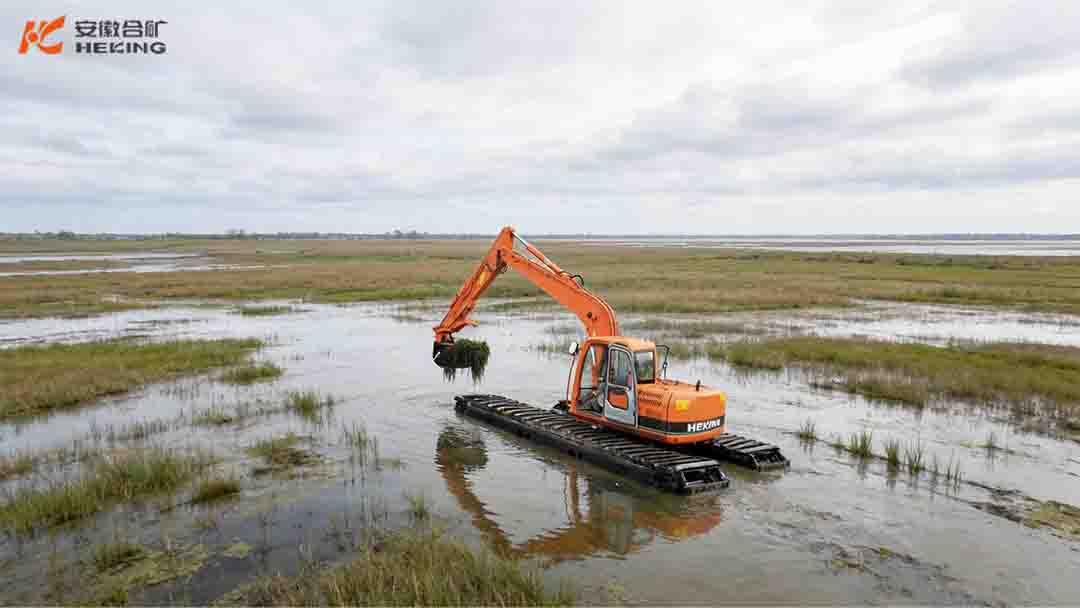
Why Marsh Projects Are Difficult for Conventional Excavators
Marsh terrain presents several challenges that are different from those found on conventional construction sites.
The ground may contain saturated soil, mud, organic material, shallow standing water, or unstable layers that cannot reliably support the concentrated load of a standard tracked excavator. Even when a machine can physically reach the work area, excessive ground pressure can result in sinking, loss of mobility, or difficult recovery.
Access is another major issue. Marsh projects often involve narrow waterways, wetland areas, drainage channels, river margins, or waterlogged construction zones where conventional access roads are unavailable or unsuitable.
The excavator therefore needs to address several requirements simultaneously:
Low ground pressure
Sufficient buoyancy where water is present
Stable operation on soft terrain
Adequate traction and mobility
Suitable digging reach and depth
Appropriate machine size for the project
A configuration that matches the site's water and ground conditions
This is why amphibious excavators are often considered when conventional excavators cannot operate effectively on soft or partially submerged terrain.
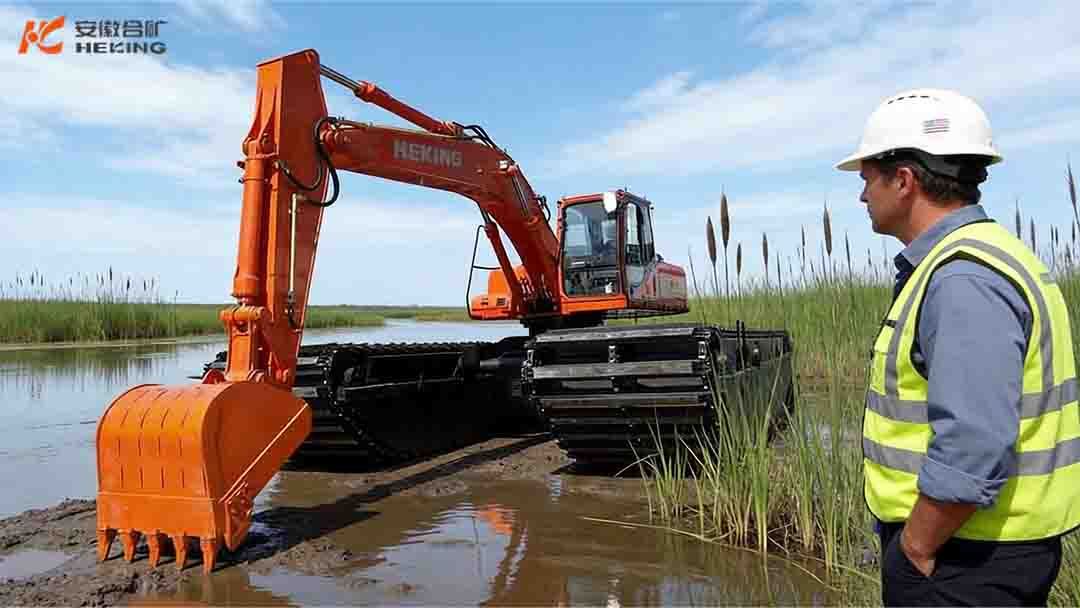
What Makes an Excavator Suitable for Marsh Projects?
There is no single specification that determines whether an excavator is suitable for every marsh project. The machine should be evaluated as a complete system.
Low Ground Pressure
Ground pressure is particularly important on marsh terrain because the supporting surface may have limited bearing capacity.
A lower ground pressure can help distribute the machine's load over a larger contact area. For example, the supplied HK150SD has a stated ground pressure of 0.13 kg/cm², while the HK200SD, HK300SD, HK300SDA, and HK400SD are each specified at 0.14 kg/cm².
These figures should not be interpreted as a universal requirement for every marsh project. Instead, they provide a useful basis for comparing machine configurations against the actual bearing conditions of a particular site.
Pontoon Undercarriage and Buoyancy
A pontoon-style undercarriage is one of the most important differences between an amphibious excavator and a conventional tracked excavator.
For marsh environments, buoyancy and the physical dimensions of the undercarriage can affect how the machine interacts with soft ground and shallow water. The supplied models use pontoon undercarriage systems and are described with big buoyancy as a feature.
The HK150SD, for example, is equipped with four motors, strengthened track shoes and chains, big buoyancy, and a hydraulic extendable undercarriage.
The HK200SD also uses four motors, strengthened track shoes and chains, big buoyancy, and either a manual extendable undercarriage or hydraulic extendable undercarriage as an option.
These configurations can be particularly relevant when a project requires mobility across soft terrain where conventional crawler equipment may have difficulty maintaining access.
Extendable Undercarriage
An extendable undercarriage can be important when operating conditions change across a project site.
The supplied HK150SD uses a hydraulic extendable undercarriage. The HK200SD offers a manual extendable undercarriage or hydraulic extendable undercarriage as an option.
The supplied dimensions also show different track gauge ranges. The HK150SD has a track gauge of 2050–3100 mm, while the HK200SD has a track gauge of 2598/3398 mm.
The correct configuration should be selected according to the project's access conditions, required working stability, transport requirements, and site geometry rather than simply choosing the widest available configuration.
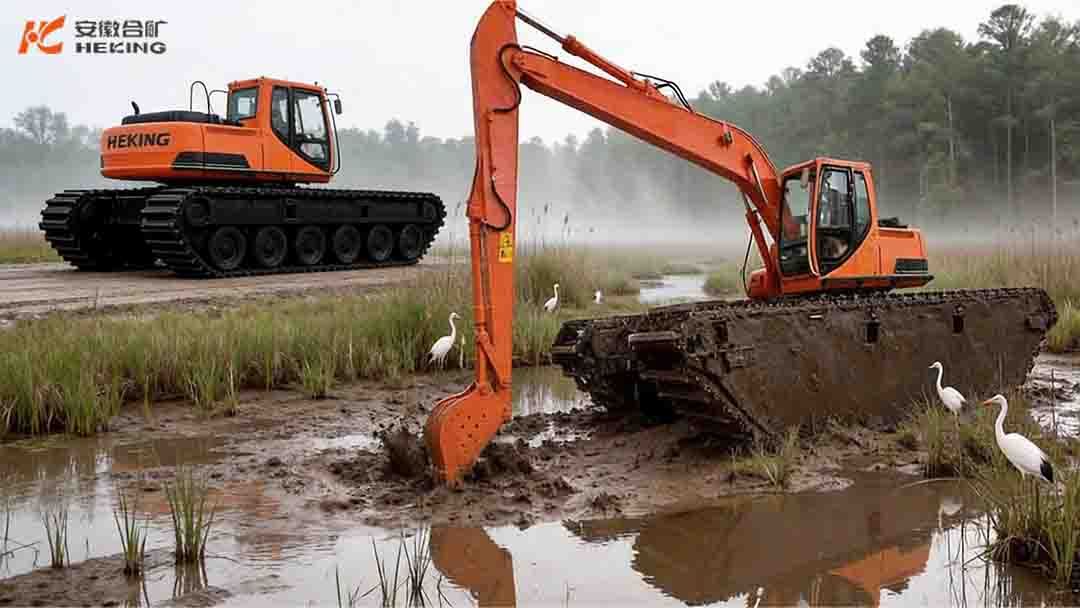
How to Choose the Best Excavator Size for a Marsh Project
Machine size should be selected according to the work rather than by operating weight alone.
The supplied range includes models from 15,000 kg to 40,000 kg, giving buyers several equipment classes to consider.
| Model | Operating Weight | Standard Bucket Capacity | Max. Digging Reach | Ground Pressure |
| HK150SD | 15,000 kg | 0.25 m³ | 8,996 mm | 0.13 kg/cm² |
| HK200SD | 20,000 kg | 0.4 m³ | 10,778 mm | 0.14 kg/cm² |
| HK300SD | 30,000 kg | 0.8 m³ | 10,186 mm | 0.14 kg/cm² |
| HK300SDA | 36,000 kg | 0.5 m³ | 15,426 mm | 0.14 kg/cm² |
| HK400SD | 40,000 kg | 1.3 m³ | 12,049 mm | 0.14 kg/cm² |
The figures above are supplied specifications and should be evaluated together with the actual project requirements.
When a Smaller Amphibious Excavator May Be Appropriate
A smaller machine can be advantageous when access limitations, transport requirements, or the scale of excavation work make a larger machine unnecessary.
The HK150SD has a stated operating weight of 15,000 kg, a 0.25 m³ standard bucket, and a maximum digging reach of 8,996 mm. Its track gauge can be adjusted from 2050 to 3100 mm.
For projects where the required excavation range and workload can be handled by a smaller machine, these characteristics may make the HK150SD a relevant option to evaluate.
When a Medium-Class Machine May Be More Suitable
The HK200SD has a stated operating weight of 20,000 kg and a 0.4 m³ standard bucket. Its maximum digging reach is 10,778 mm, with a maximum digging depth of 7,033 mm.
Its track gauge is specified as 2598/3398 mm, with an overall width of 4231 mm when retracted and 5051 mm when extended.
For marsh projects requiring more excavation capacity or reach than a 15-ton-class machine provides, the HK200SD offers another configuration for consideration.
When Larger Excavators Are Needed
Larger amphibious excavators may be appropriate when the project requires greater excavation capacity, stronger digging performance, or a longer working range.
The HK300SD has a stated operating weight of 30,000 kg and a 0.8 m³ standard bucket. The HK400SD increases the stated operating weight to 40,000 kg and has a 1.3 m³ standard bucket.
The HK300SDA takes a different approach. Its stated total weight is 36,000 kg, with an 8,600 mm boom, 6,260 mm arm, and maximum digging reach of 15,426 mm. This long-reach configuration may be particularly relevant when the project requires extended working distance.
Machine size should therefore be matched to the excavation task, required reach, access conditions, and site stability rather than selected only on the basis of nominal operating weight.
Comparing Amphibious Excavators for Marsh Conditions
Different marsh projects can require substantially different machine configurations.
The following comparison focuses on supplied specifications that can help buyers begin the selection process.
| Model | Operating Weight | Bucket Capacity | Boom Length | Arm Length | Max. Digging Depth | Max. Digging Reach |
| HK150SD | 15,000 kg | 0.25 m³ | 4,500 mm | 3,000 mm | 5,879 mm | 8,996 mm |
| HK200SD | 20,000 kg | 0.4 m³ | 6,100 mm | 3,900 mm | 7,033 mm | 10,778 mm |
| HK300SD | 30,000 kg | 0.8 m³ | 5,680 mm | 2,912 mm | 3,201 mm | 10,186 mm |
| HK300SDA | 36,000 kg | 0.5 m³ | 8,600 mm | 6,260 mm | 10,858 mm | 15,426 mm |
| HK400SD | 40,000 kg | 1.3 m³ | 6,733 mm | 4,520 mm | 7,396 mm | 12,049 mm |
The differences illustrate why a machine with a higher operating weight is not automatically the best choice for every marsh application. Working reach, boom and arm configuration, bucket capacity, digging depth, ground pressure, and undercarriage configuration can all influence suitability.
Which Excavator Features Matter Most in Marsh Projects?
When evaluating equipment, buyers should prioritize the characteristics that directly affect the machine's ability to access and perform work on the site.
1. Ground Conditions
Start by identifying the actual condition of the working surface.
Consider whether the site consists primarily of:
Saturated soil
Mud
Soft ground
Shallow water
Marshland
Waterlogged construction areas
River or drainage margins
The more difficult the ground conditions, the more important the undercarriage, flotation, ground pressure, and mobility characteristics become.
2. Required Digging Reach
The required working radius should be established before selecting a machine.
A project may require the excavator to work from a relatively stable position while reaching into soft ground, a drainage channel, or shallow water. In such cases, digging reach can be more important than simply choosing a larger bucket.
The supplied models have maximum digging reaches ranging from 8,996 mm on the HK150SD to 15,426 mm on the HK300SDA.
3. Required Digging Depth
Digging depth should be evaluated according to the actual excavation profile.
For example, the supplied HK200SD has a maximum digging depth of 7,033 mm, while the HK300SDA has a stated maximum digging depth of 10,858 mm.
These values are machine specifications, not recommended operating depths for every marsh environment. Actual performance depends on the site, configuration, attachment, and working conditions.
4. Mobility and Track Configuration
Marsh projects can require movement through areas where conventional access is difficult.
The number of travel motors, track configuration, track gauge, pontoon dimensions, and undercarriage design should therefore be reviewed as part of the equipment selection process.
The supplied machines use specialized pontoon undercarriages, with the HK150SD, HK200SD, and HK300SDA specified with four travel motors.
5. Working Stability
A marsh excavator must provide a workable platform for digging, swinging, and material handling.
The machine's undercarriage dimensions and configuration should be considered together with the site's soil and water conditions. A wider working configuration may affect stability and access differently from a narrower transport configuration.
For this reason, buyers should provide the equipment supplier with accurate site information before finalizing the machine configuration.
Matching Excavator Configuration to Different Marsh Applications
Marsh excavation is not a single type of project. The equipment requirement can change considerably depending on the work being performed.
Wetland Construction
Wetland construction can involve soft, waterlogged, or difficult-to-access terrain. In these conditions, an amphibious undercarriage can be considered when conventional excavator access is impractical.
The key evaluation factors include ground pressure, buoyancy, mobility, working reach, and the required excavation capacity.
River Dredging and Waterway Work
River and waterway projects may require the machine to work alongside or within wet areas while maintaining sufficient reach for excavation.
The HK300SD is specifically supplied with river dredging listed among its applications. Its stated maximum digging reach is 10,186 mm, with a standard bucket capacity of 0.8 m³.
The machine should still be evaluated against the specific water, soil, reach, and excavation requirements of the project.
Flood Control Projects
Flood control work can involve waterlogged ground, drainage channels, embankment-related excavation, and other difficult-access conditions.
The HK300SD supplied information specifically lists flood control projects among its applications. Buyers evaluating this type of equipment should define the required excavation range, working environment, access conditions, and expected workload before choosing a machine.
Coastal Engineering
Coastal projects can combine soft ground, water, and difficult access.
The supplied HK300SD information lists coastal engineering among its applications. For such projects, the machine configuration should be evaluated according to the actual site conditions and required excavation work rather than assuming that one standard configuration is suitable for every coastal project.
Oil and Gas Pipeline Projects
Pipeline construction and related excavation work can require equipment capable of reaching difficult sections of a project while working across challenging terrain.
The supplied HK300SD information lists oil and gas pipeline projects as an application. Buyers should define the required excavation depth, working reach, access conditions, and site constraints before selecting the machine configuration.
What Information Should Buyers Provide When Requesting a Marsh Excavator?
A supplier can make a more useful equipment recommendation when the buyer provides detailed project information.
At minimum, prepare:
| Project Information | Why It Matters |
| Ground condition | Helps determine the appropriate undercarriage and mobility requirements |
| Water conditions | Helps establish whether amphibious or pontoon-based equipment is appropriate |
| Required digging depth | Helps identify suitable machine working range |
| Required digging reach | Helps determine boom, arm, and machine configuration |
| Excavation workload | Helps evaluate appropriate machine size and bucket capacity |
| Access limitations | Helps evaluate transport and undercarriage dimensions |
| Working area dimensions | Helps assess track gauge and overall machine configuration |
| Attachment requirements | Helps establish the required working configuration |
| Project location | Important for logistics, delivery, and export requirements |
| Required delivery schedule | Helps align the equipment with project planning |
This information is more useful for equipment selection than simply asking for the "largest" or "best" excavator.
Common Mistakes When Choosing an Excavator for Marsh Projects
Several common selection mistakes can lead to an unsuitable machine configuration.
Choosing Based Only on Operating Weight
A heavier machine is not automatically better for soft ground. Ground pressure, buoyancy, undercarriage design, digging range, and project requirements also need to be evaluated.
Ignoring Transport Dimensions
An excavator may be suitable for the working area but difficult to transport to the site if its overall dimensions and configuration are not considered in advance.
Selecting Bucket Capacity Without Considering the Project
A larger bucket can increase excavation capacity, but bucket size should be considered together with the machine's hydraulic system, digging requirements, ground conditions, and overall project workload.
Assuming One Amphibious Configuration Fits Every Marsh
Marsh conditions vary significantly. Water depth, soil strength, required reach, access, and excavation requirements can all change from one project to another.
The right approach is to specify the project first and then select the machine configuration.
How to Evaluate the Best Excavator for Your Marsh Project
A practical selection process can be divided into five steps.
Step 1: Define the Working Environment
Record whether the machine will operate on soft ground, in shallow water, on muddy terrain, or across a combination of conditions.
Step 2: Define the Excavation Requirements
Establish the required digging depth, reach, bucket capacity, and type of excavation work.
Step 3: Evaluate the Undercarriage
Compare pontoon dimensions, track gauge, ground clearance, buoyancy-related configuration, and travel system characteristics.
Step 4: Match Machine Size to the Workload
Compare available models based on operating weight, bucket capacity, digging range, and project requirements.
Step 5: Confirm the Configuration With the Supplier
Provide site information and request confirmation of the proposed machine configuration before placing an order. For specialized marsh projects, the configuration should be evaluated as a complete engineering solution rather than selected from a single specification.
FAQ About Choosing an Excavator for Marsh Projects
What type of excavator is best for marsh projects?
An amphibious excavator is often worth considering for marsh projects because it is designed around soft, wet, and difficult-access working environments. The appropriate model still depends on ground conditions, water conditions, required reach, digging depth, workload, and machine configuration.
Is lower ground pressure important for marsh excavation?
Yes. Ground pressure is an important factor when working on soft or saturated terrain because the supporting surface may have limited bearing capacity. It should be evaluated together with the machine's undercarriage and actual site conditions.
Which HEKING model has the longest stated digging reach in the supplied range?
Among the supplied models, the HK300SDA has the longest stated maximum digging reach at 15,426 mm. Its maximum digging reach on ground is specified as 15,203 mm.
Which supplied model has the largest standard bucket capacity?
The HK400SD has the largest stated standard bucket capacity in the supplied range at 1.3 m³.
Is the largest excavator always the best choice for marsh work?
No. Machine selection should be based on the project environment and work requirements. A larger machine may provide greater capacity, but access, ground conditions, required reach, transport, and undercarriage configuration can make another model more appropriate.
What should I provide when requesting a quotation for a marsh excavator?
Provide the working environment, ground and water conditions, required digging depth and reach, excavation workload, access limitations, preferred attachment, project location, and expected delivery schedule. Detailed project information allows the supplier to evaluate the appropriate configuration more accurately.
Conclusion: Choosing the Right Excavator for Marsh Projects
The best excavator for a marsh project is not simply the machine with the greatest weight, engine power, or bucket capacity. The right choice depends on how well the complete machine configuration matches the working environment and excavation requirements.
For soft and waterlogged terrain, important factors include pontoon undercarriage design, ground pressure, buoyancy, mobility, track configuration, working reach, digging depth, and machine size. The supplied HK150SD, HK200SD, HK300SD, HK300SDA, and HK400SD provide different configurations that can be evaluated according to project requirements.
For a professional equipment purchase, buyers should provide detailed site and excavation information before selecting the final model. This helps ensure that the excavator configuration is appropriate for the actual marsh conditions rather than being selected from specifications alone.
If you are planning a marsh excavation, wetland construction, river dredging, flood control, coastal engineering, or another soft-ground project, contact the supplier with your project requirements and request a suitable amphibious excavator configuration and quotation.