
Heavy duty excavation becomes significantly more demanding when projects move beyond firm, stable ground. Marshes, wetlands, waterlogged sites, soft soil, shallow-water areas and difficult shorelines can limit the mobility of conventional excavation equipment. In these conditions, an amphibious excavator provides a specialized approach by combining excavation capability with an undercarriage and pontoon arrangement designed for difficult terrain.
For contractors, environmental engineering companies, dredging specialists and equipment procurement teams, selecting a heavy duty amphibious excavator is not simply a matter of choosing the largest machine available. Ground pressure, flotation, stability, digging reach, hydraulic performance, mobility, transport dimensions and attachment requirements all need to be considered together.
This guide explains the main engineering factors behind heavy duty amphibious excavators and uses the supplied HEKING HK400SD and HK300SDA specifications as practical examples of how different machine configurations can address demanding excavation requirements.
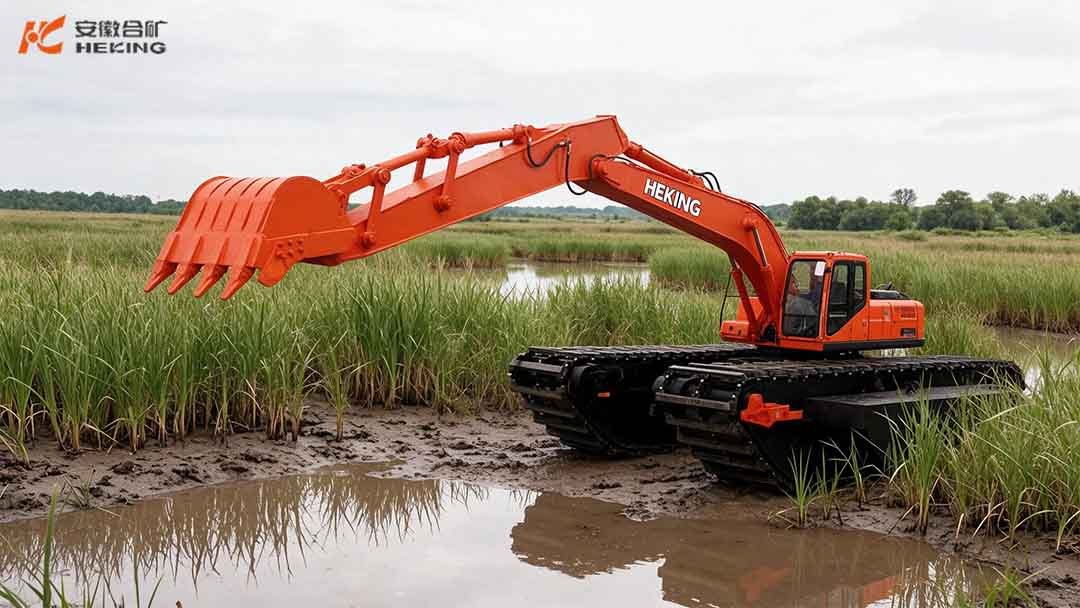
What Is a Heavy Duty Amphibious Excavator?
A heavy duty amphibious excavator is a specialized excavator configuration designed for excavation work where conventional tracked equipment may face difficult ground conditions. The machine combines an excavator upper structure with an amphibious undercarriage and pontoon-based support system.
The purpose of the amphibious configuration is not simply to make an excavator larger or more powerful. Its engineering value comes from adapting the machine to environments where ground bearing conditions, water presence and access are major constraints.
Important characteristics can include:
Low ground pressure
Large supporting surface area
Pontoon-based flotation
Amphibious track systems
Adequate traction for soft terrain
Sufficient hydraulic power for excavation attachments
Long working reach where access is restricted
Appropriate machine stability for the project conditions
The exact configuration required depends on the site. A wetland restoration project, for example, may have different requirements from a waterway desilting project or a shoreline excavation project.
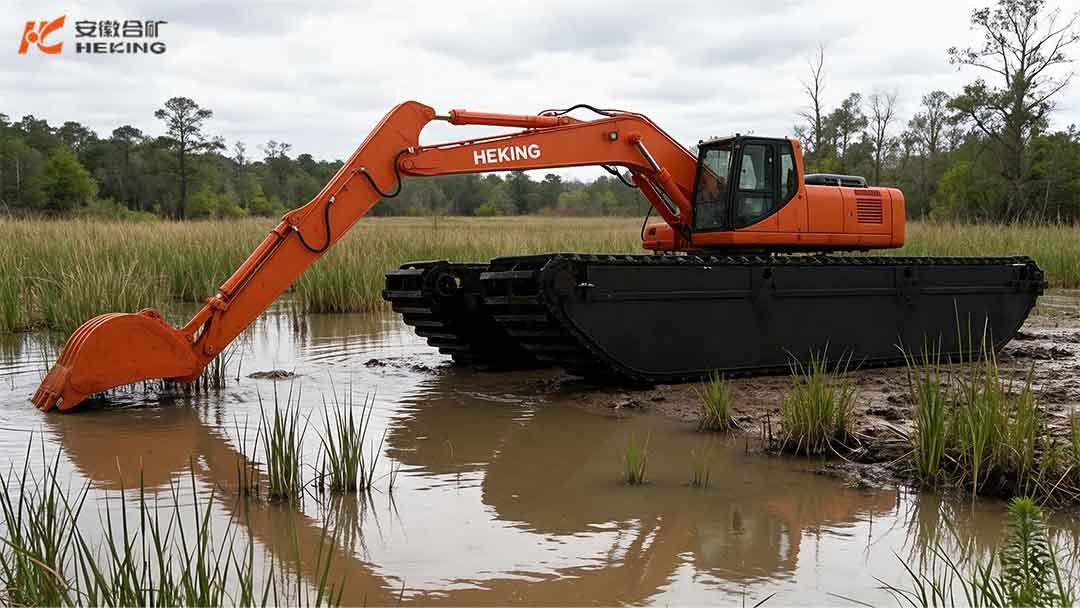
Why Heavy Duty Excavation Is Difficult on Soft and Wet Ground
Conventional excavation equipment generally performs most effectively when the ground can support the machine's weight and provide sufficient traction.
Soft or saturated terrain changes this operating environment.
If the supporting soil cannot adequately carry the machine, the equipment may experience excessive sinking, reduced mobility or difficulty repositioning. Waterlogged ground can also make access routes unpredictable, while mud and sediment can affect traction and machine stability.
A heavy duty amphibious configuration addresses these challenges through several related engineering principles.
Ground Pressure and Load Distribution
Ground pressure is an important consideration when selecting equipment for soft terrain.
In simple terms, distributing machine weight over a larger supporting area can reduce the load applied to the ground at individual contact areas. This can help an amphibious machine operate in terrain where conventional equipment may encounter greater mobility challenges.
Ground pressure should therefore be evaluated together with actual soil conditions rather than treated as an isolated specification.
The supplied HK400SD has a stated ground pressure of 0.14 kg/cm². The HK300SDA also has a stated ground pressure of 0.14 kg/cm².
These figures are product-specific specifications and should not be generalized to other HEKING models or amphibious excavators.
Flotation and Pontoon Support
Pontoon systems provide another important part of amphibious machine design.
The pontoon structure contributes to the machine's supporting area and flotation characteristics. For projects involving saturated soil, marshland or shallow-water working environments, buyers should understand how the complete undercarriage and pontoon configuration interacts with the site.
The supplied HK300SDA information specifically identifies large buoyancy as an undercarriage characteristic and lists Q345B material for its undercarriage structure. It also specifies pontoon dimensions and provides additional pontoon and spud as optional configurations.
These details demonstrate why flotation should be evaluated as part of the complete machine configuration rather than treated as a simple machine-size issue.
Traction and Soft-Ground Mobility
Flotation alone does not guarantee useful mobility.
An amphibious excavator also needs sufficient traction and an undercarriage configuration suited to the terrain. Track design, drive motors, machine weight distribution and ground conditions all influence practical mobility.
For heavy duty projects, buyers should therefore examine:
Number and arrangement of travel motors
Track and chain configuration
Traction capability
Ground pressure
Pontoon dimensions
Ground clearance
Terrain slope
Expected mud and sediment conditions
The HK400SD specification lists three chains, a maximum travel speed of 2.1 km/h in high range and 1.2 km/h in low range, together with a stated gradeability of 70% and tractive effort of 4 × 116 kN.
The HK300SDA specification identifies four travel motors, strengthened track shoes and chains, and a stated gradeability of 35° (70%).
These figures belong to their respective machines and should be evaluated according to the actual project environment.
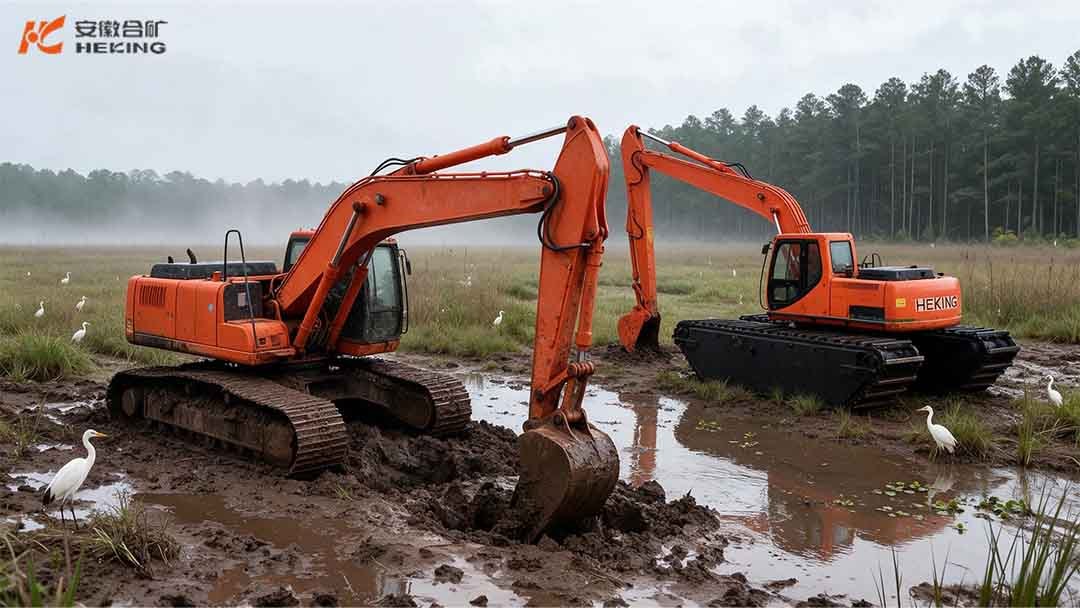
Key Technical Factors in Heavy Duty Amphibious Excavator Selection
A suitable machine must match the excavation task as well as the terrain.
For B2B buyers, several technical parameters deserve particular attention.
Machine Weight and Ground Conditions
Machine weight affects transportation, ground loading and flotation requirements.
The supplied HK400SD has a stated weight of 40,000 kg, while the HK300SDA has a stated total weight of 36,000 kg.
Weight should never be considered independently. A heavier machine can still be suitable for difficult terrain when the undercarriage and supporting structure are appropriately designed, but the complete configuration must correspond to the site's ground-bearing and flotation conditions.
Working Reach and Excavation Geometry
Reach becomes especially important when the machine cannot position itself directly beside the excavation area.
The HK400SD has a maximum digging reach of 12,049 mm, a maximum digging reach on ground of 11,687 mm, and a maximum digging depth of 7,396 mm.
The HK300SDA has a maximum digging reach of 15,426 mm, a maximum digging reach on ground of 15,203 mm, and a maximum digging depth of 10,858 mm.
These specifications illustrate why machine selection should consider the geometry of the project rather than relying only on operating weight or engine power.
A contractor working from a restricted access position may place greater importance on working reach and digging depth than a contractor working directly beside an excavation area.
Hydraulic System
Hydraulic performance directly affects the operation of the excavator's working equipment.
The HK400SD is supplied with a variable plunger pump system with a maximum displacement of 2 × 140 cm³/r, maximum flow of 2 × 308 L/min, and stated working pressure of 32 MPa / 34.3 MPa.
The HK300SDA uses a variable plunger pump system with a maximum displacement of 2 × 112 cm³/r, maximum flow of 2 × 240 L/min, and stated working pressure of 32 MPa.
For equipment buyers, the key point is that hydraulic specifications should be evaluated alongside the intended attachment and excavation task. A machine's hydraulic configuration needs to be appropriate for the equipment that will actually be used on the project.
Engine and Power
Engine output is another important factor for heavy duty excavation.
The HK400SD is specified with Cummins QSB6.7, Cummins C8.3 or Isuzu 6HK1 engine options and a stated power of 183.9 kW at 2,200 rpm.
The HK300SDA is specified with Mitsubishi 4M50-TLC3J or Isuzu 6BG1TRP-03 engine options and a stated power of 118 kW at 2,000 rpm.
Engine selection should be considered together with hydraulic demand, machine size, operating conditions and the expected workload.
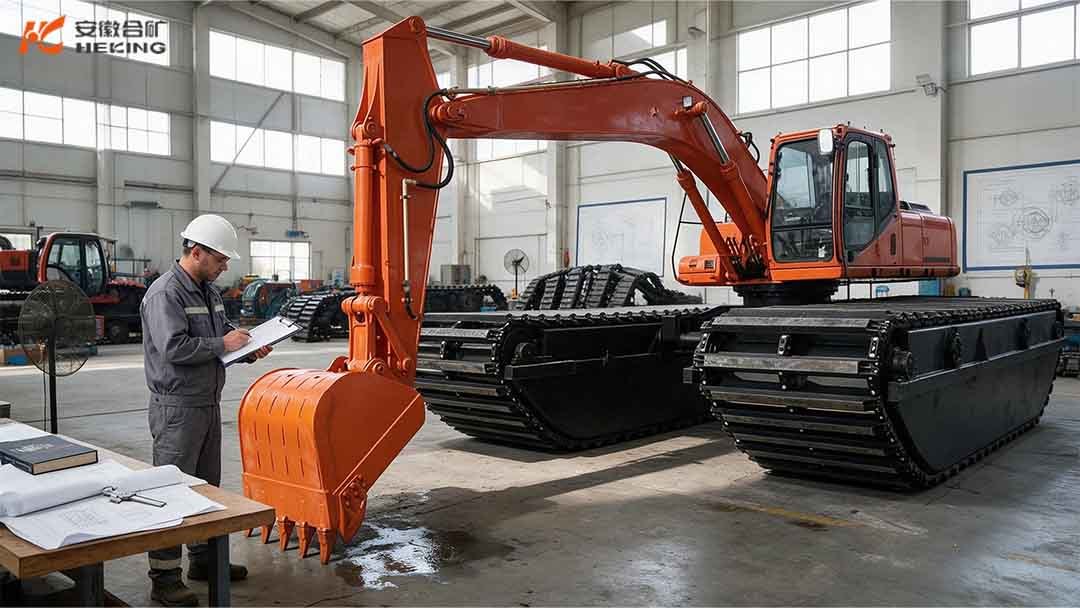
Comparing the HK400SD and HK300SDA for Heavy Duty Applications
Both supplied HEKING models are relevant examples for understanding heavy duty amphibious excavator configurations, but their specifications are not identical.
| Factor | HK400SD | HK300SDA |
|---|---|---|
| Stated weight | 40,000 kg | 36,000 kg |
| Standard bucket capacity | 1.3 m³ | 0.5 m³ |
| Boom length | 6,733 mm | 8,600 mm |
| Arm length | 4,520 mm | 6,260 mm |
| Ground pressure | 0.14 kg/cm² | 0.14 kg/cm² |
| Maximum digging reach | 12,049 mm | 15,426 mm |
| Maximum digging depth | 7,396 mm | 10,858 mm |
| Maximum travel speed | 2.1 km/h | 3.3 km/h |
| Stated gradeability | 70% | 35° (70%) |
The comparison shows why the term "heavy duty" should not be interpreted as weight alone.
The HK400SD combines a 40,000 kg stated weight with a 1.3 m³ standard bucket capacity, 183.9 kW engine power and a 12,049 mm maximum digging reach.
The HK300SDA has a lower stated weight of 36,000 kg but a longer boom and arm configuration, resulting in a stated maximum digging reach of 15,426 mm and maximum digging depth of 10,858 mm.
For procurement teams, this means that the better machine depends on the project rather than simply on which model has the larger basic specification.
What Projects Can Require a Heavy Duty Amphibious Excavator?
Heavy duty amphibious equipment can be considered when excavation must take place in environments where access, soil bearing capacity or water presence creates a challenge for conventional equipment.
Potential project environments include wetland work, marsh and swamp excavation, waterway maintenance, desilting, dredging-related excavation, drainage channel maintenance and shoreline work.
The equipment requirement should be defined by the actual project conditions.
Wetland and Marsh Projects
Wetlands and marshes can combine saturated soil, unstable surfaces and restricted access.
For these projects, contractors should evaluate ground pressure, flotation, mobility and the machine's working reach. The objective is not simply to place an excavator in wet terrain, but to establish whether the complete machine configuration can safely and effectively reach the required working area.
Waterway Maintenance and Desilting
Waterway maintenance can involve sediment, restricted bank access and working positions where conventional excavators cannot easily approach the required excavation zone.
In these situations, working reach and machine positioning can become particularly important. Attachment selection is also critical because the required tool should correspond to the material and task being performed.
The machine should be selected after considering the water conditions, sediment characteristics, required excavation geometry and access arrangements.
Environmental and Shoreline Work
Environmental engineering projects may require excavation near water, soft ground or sensitive terrain.
Equipment selection should therefore consider not only excavation performance but also mobility, stability, site access and the operational constraints of the project.
Where environmental restrictions apply, contractors should define site requirements clearly before equipment selection and quotation.
How to Select the Right Heavy Duty Amphibious Excavator
A structured selection process helps prevent a machine from being chosen solely on a single specification.
Start with the working environment.
Determine whether the machine will operate on saturated soil, marsh, mud, shallow water, a shoreline or another difficult terrain condition.
Next, define the excavation task.
Consider the required digging reach, digging depth, bucket capacity, attachment type and working position. If the machine cannot approach the excavation point directly, reach may become one of the most important parameters.
Then evaluate the machine configuration.
Important factors include:
Ground pressure
Pontoon dimensions
Ground clearance
Track configuration
Travel motors
Traction
Engine power
Hydraulic flow
Hydraulic pressure
Working reach
Digging depth
Transport dimensions
Maintenance access
Finally, evaluate project logistics.
A heavy duty amphibious excavator is a large piece of specialized equipment, so transport dimensions, delivery arrangements, assembly requirements and site access should be considered before ordering.
What Information Should Buyers Provide When Requesting a Quotation?
A supplier can make a more useful technical recommendation when the buyer provides clear project information.
A B2B quotation request should ideally describe:
Project type
Working environment
Soil and ground conditions
Presence and approximate nature of water conditions
Required digging area
Required working reach
Required digging depth
Preferred bucket or attachment
Required machine transport constraints
Expected operating conditions
Project location
Delivery requirements
Any special configuration or customization requirements
Providing this information helps separate a genuine equipment requirement from a simple request for a machine price.
For specialized amphibious equipment, the engineering context behind the quotation can be as important as the basic product model.
Heavy Duty Amphibious Excavator Maintenance Considerations
Maintenance planning should begin before the machine enters the project site.
An amphibious excavator operates in environments where mud, water, sediment and difficult access can place additional demands on equipment inspection and servicing.
A practical maintenance program should account for the machine's engine, hydraulic system, travel system, swing system, tracks, chains and pontoon-related structure.
Operators and maintenance teams should also pay attention to conditions that may affect access to service points or inspection areas.
The exact maintenance schedule should follow the equipment manufacturer's technical documentation and the actual operating environment rather than relying on a generic excavator maintenance routine.
Frequently Asked Questions
What is a heavy duty amphibious excavator used for?
A heavy duty amphibious excavator is used for excavation and related work in difficult terrain where soft ground, waterlogged soil, shallow water or restricted access can create challenges for conventional excavators. Potential applications include wetland work, waterway maintenance, desilting, shoreline work and environmental engineering.
Why is ground pressure important for amphibious excavators?
Ground pressure indicates how the machine's load is distributed over its supporting surface. Lower ground loading can be beneficial when working on soft or unstable terrain, but ground pressure should always be evaluated together with soil conditions, flotation, traction and overall machine stability.
Is a heavier amphibious excavator always better?
No. Machine selection depends on the complete project requirement. Weight, bucket capacity, reach, digging depth, hydraulic performance, flotation, ground pressure and transport requirements should all be considered together.
What is important when selecting an amphibious excavator for dredging or desilting?
Buyers should consider the water and sediment conditions, required working position, excavation reach and depth, attachment requirements, machine flotation and mobility, hydraulic requirements, transport logistics and maintenance requirements.
What makes the HK400SD relevant to heavy duty excavation?
The supplied HK400SD specifications include a stated 40,000 kg weight, 1.3 m³ standard bucket capacity, 183.9 kW engine power, 0.14 kg/cm² ground pressure, 12,049 mm maximum digging reach and 7,396 mm maximum digging depth. These specifications provide a concrete example of a heavy duty amphibious excavator configuration.
How should buyers compare the HK400SD and HK300SDA?
The two models should be compared according to the project's actual requirements. The supplied specifications show differences in weight, bucket capacity, boom and arm dimensions, reach, digging depth, travel speed and engine power. A project requiring longer working reach may prioritize different characteristics from one requiring a larger standard bucket capacity.
Conclusion: Match the Amphibious Excavator to the Project
Choosing a heavy duty amphibious excavator requires more than comparing machine weight or engine power. The most important question is how the complete machine configuration corresponds to the project's terrain, water conditions, excavation geometry and operational requirements.
Ground pressure, flotation, pontoon design, traction, working reach, hydraulic performance, attachment requirements and transport logistics should be evaluated as an integrated system.
The supplied HEKING HK400SD and HK300SDA specifications demonstrate how two heavy duty amphibious excavator configurations can have different combinations of weight, reach, bucket capacity and working dimensions. This is why professional equipment selection should begin with the project conditions rather than a model name alone.
For contractors, engineering companies, dredging specialists and equipment procurement teams, providing detailed project information is the best starting point for determining an appropriate amphibious equipment configuration. Contact HEKING to discuss your project conditions, equipment requirements and quotation needs.