
Oil and gas pipeline projects often cross terrain that creates major challenges for conventional construction equipment. Wetlands, marshes, soft soil, waterlogged ground, drainage areas, and unstable access routes can make it difficult for standard excavators to move safely and efficiently.
An amphibious excavator is designed to address this type of difficult terrain by combining excavation capability with a specialized pontoon-based undercarriage that improves flotation and mobility on soft and wet ground. For pipeline contractors, the equipment can be relevant during excavation, access preparation, drainage work, trench-related operations, and other construction activities where ground conditions limit the use of conventional tracked machinery.
This article explains how amphibious excavators can support oil and gas pipeline projects, which engineering factors matter when evaluating equipment, and how different machine configurations may relate to different project requirements.
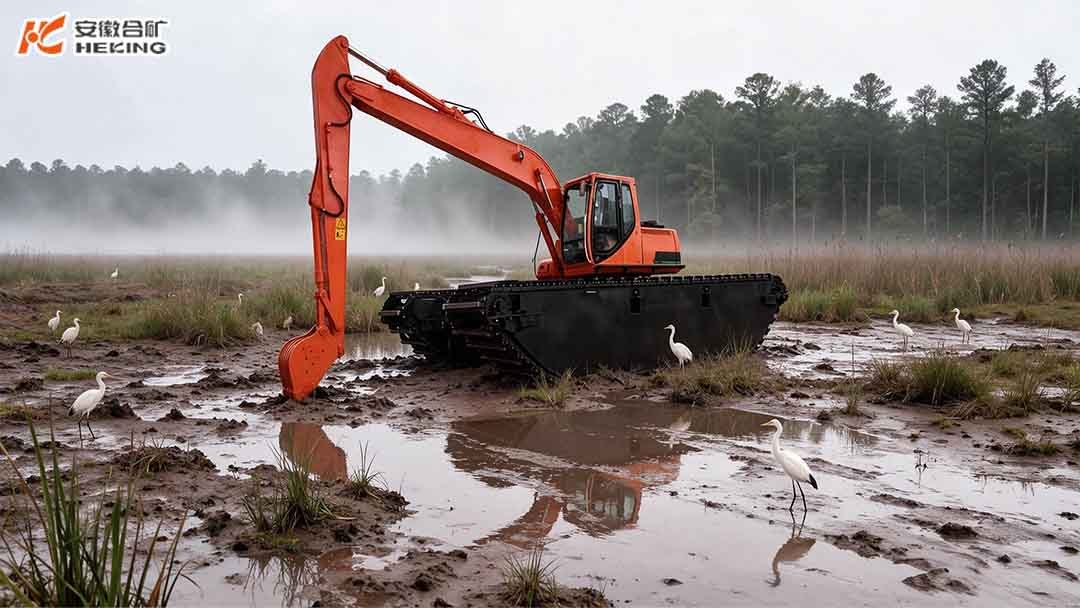
Why Pipeline Projects Create Difficult Terrain Challenges
Pipeline routes are determined by infrastructure and geographic requirements rather than by equipment convenience. As a result, contractors may need to work across land with highly variable ground conditions.
A single pipeline project may include firm construction areas as well as sections containing saturated soil, marshland, drainage channels, wetlands, or other soft-ground environments. Heavy equipment operating in these conditions can face problems with ground bearing capacity, mobility, traction, and site access.
A conventional excavator concentrates its operating weight through its undercarriage and tracks. When the supporting ground is weak, the machine may sink, lose mobility, or require additional access preparation before productive work can begin.
For pipeline contractors, this can create several practical challenges:
Maintaining equipment access along the pipeline route
Working near waterlogged or saturated ground
Moving equipment through soft and unstable terrain
Performing excavation where conventional machines have limited mobility
Reducing dependence on temporary ground access solutions where specialized equipment may be more appropriate
Matching machine reach and digging capability to the required working area
The appropriate equipment solution depends on the actual site conditions. Soil characteristics, water conditions, terrain stability, required excavation range, and project logistics should all be evaluated before selecting a machine.
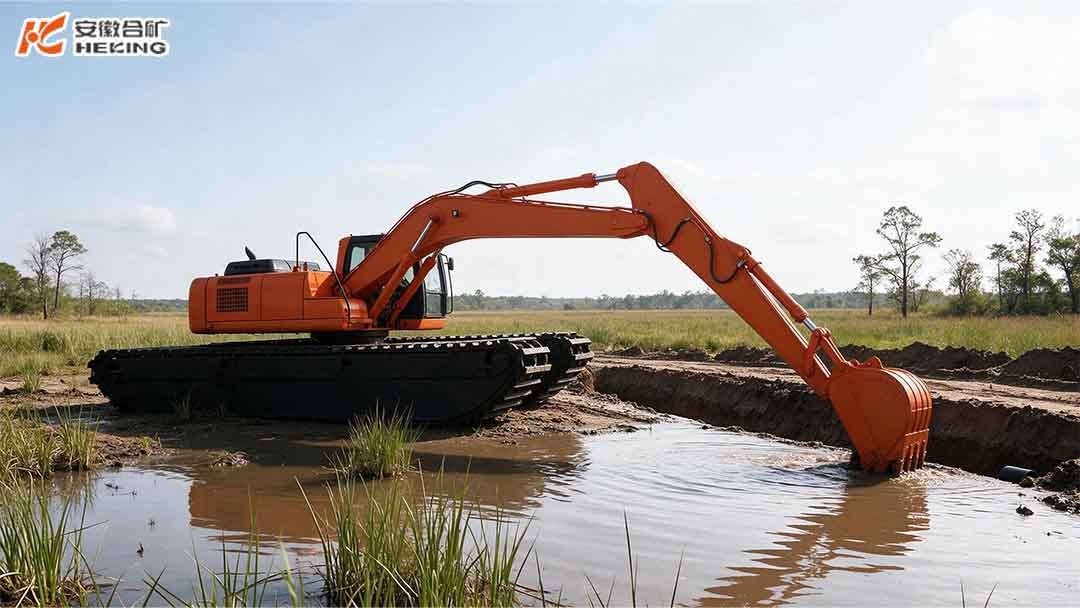
How Amphibious Excavators Improve Mobility on Soft Ground
The main difference between an amphibious excavator and a conventional excavator is the specialized undercarriage designed for difficult terrain.
An amphibious undercarriage typically uses large pontoon structures to provide flotation and distribute machine weight across a larger supporting area. This engineering approach helps reduce ground loading and can improve mobility on soft, muddy, saturated, or shallow-water terrain.
The principle is especially relevant for pipeline projects because access conditions can change significantly along a construction route.
Flotation and Ground Pressure
Flotation is an important consideration when equipment must operate on soft terrain. By increasing the supporting area, a pontoon-based undercarriage can distribute machine weight differently from a conventional undercarriage.
Several of the supplied HEKING amphibious excavator models have low stated ground-pressure values. For example, the HK150SD is specified at 0.13 kg/cm², while the HK200SD, HK300SD, HK300SDA, and HK400SD are specified at 0.14 kg/cm².
These values should be considered together with the complete machine configuration and actual site conditions rather than as the only selection criterion.
Traction and Machine Movement
Pipeline projects may require equipment to travel along uneven, wet, or soft construction corridors. Mobility depends on more than flotation alone.
The undercarriage design, track configuration, travel motors, terrain conditions, and machine size all influence how equipment moves through a project site.
The supplied HEKING models include specialized pontoon undercarriage configurations with features such as strengthened track shoes and chains. Several models also specify four travel motors and extendable undercarriage configurations.
For projects with changing terrain conditions, the relationship between undercarriage dimensions and site access can be an important engineering consideration.
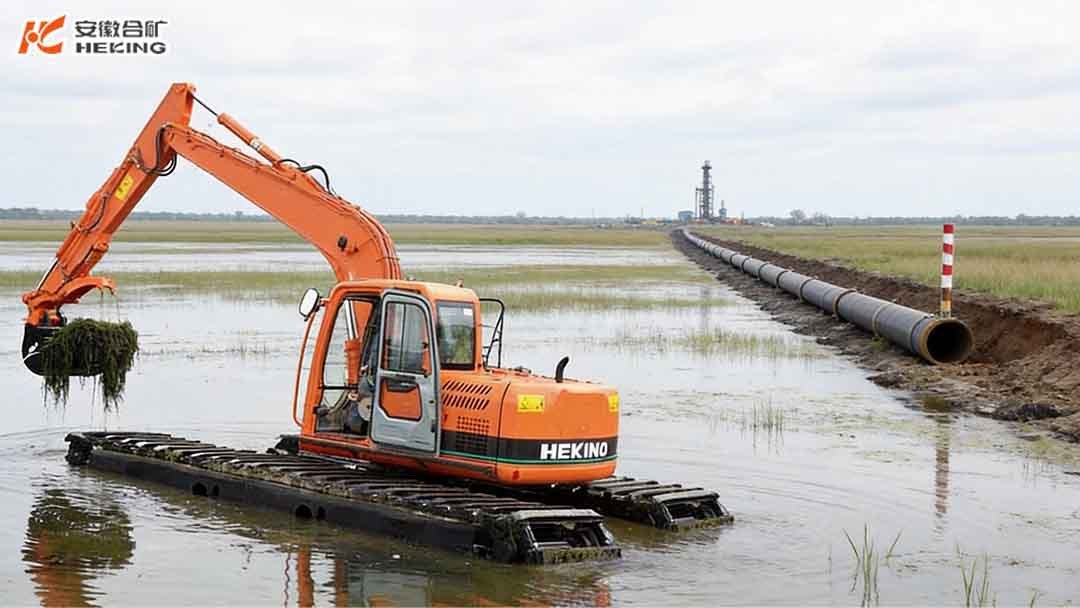
Where Amphibious Excavators Can Support Pipeline Construction
Amphibious excavators are not a replacement for every type of pipeline construction equipment. Their value is greatest where terrain conditions create mobility or access challenges.
Wetland and Marsh Crossings
Pipeline routes may pass through wetlands or marshy areas where saturated ground limits the use of conventional heavy equipment.
In these environments, contractors must evaluate equipment flotation, ground loading, stability, and mobility. A pontoon-based amphibious excavator can provide an equipment approach specifically suited to soft and wet terrain.
Environmental requirements and project-specific operating restrictions should also be considered when planning work in sensitive areas.
Waterlogged Construction Corridors
Some pipeline construction areas experience persistent waterlogging because of rainfall, poor drainage, seasonal conditions, or naturally saturated soil.
An amphibious excavator may be considered where the main equipment challenge is maintaining mobility and excavation capability in these difficult ground conditions.
Before selecting equipment, contractors should assess the actual operating surface rather than relying only on general descriptions such as "wet ground."
Drainage and Water Management Work Along Pipeline Routes
Pipeline construction and maintenance can involve drainage-related excavation and water management activities.
Where drainage channels, saturated ground, or waterlogged access areas are present, amphibious equipment may provide greater terrain adaptability than conventional equipment designed primarily for firm ground.
The required working reach, excavation depth, access route, and operating environment should determine the appropriate machine configuration.
Soft-Ground Access Preparation
Access is often a major issue in linear infrastructure projects.
Equipment may need to move along long construction corridors where ground conditions vary from section to section. A machine suitable for one area may not be suitable for another.
Amphibious excavators can be relevant where soft-ground mobility is a central equipment challenge and where the project requires both movement and excavation capability.
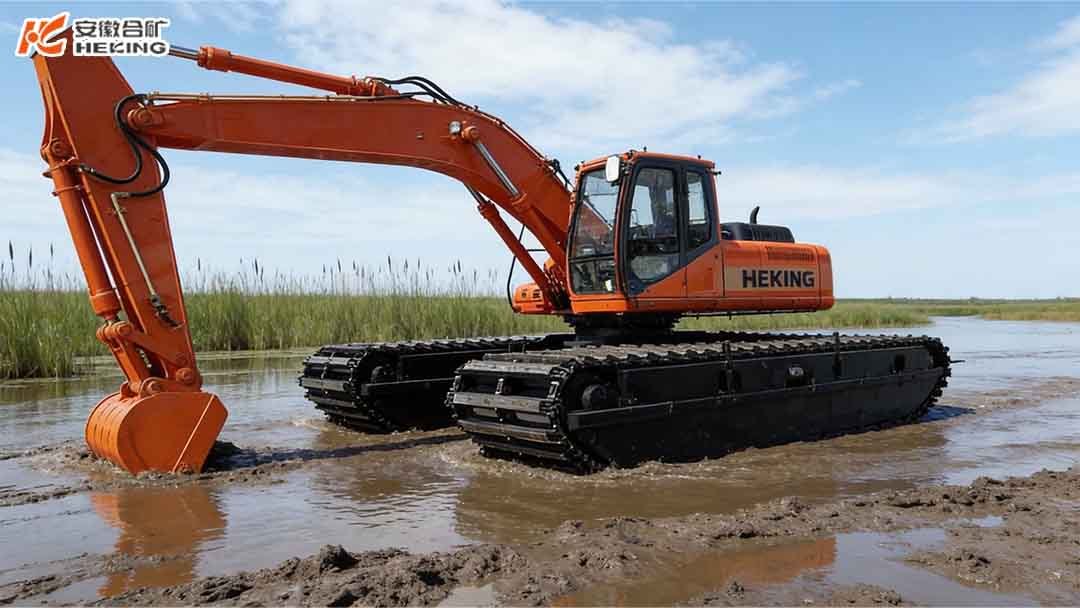
Reach and Excavation Requirements for Pipeline Work
Pipeline projects can require different working ranges depending on the construction method and site layout.
An equipment selection process should therefore consider:
Required digging reach
Working distance from the machine position
Required excavation depth
Boom and arm configuration
Available operating space
Ground stability at the machine location
The supplied HEKING models cover different machine sizes and working configurations.
For example, the HK150SD has a specified maximum digging reach of 8,996 mm and maximum digging depth of 5,879 mm. The HK200SD has a specified maximum digging reach of 10,778 mm and maximum digging depth of 7,033 mm.
For projects requiring a substantially longer working range, the HK300SDA is supplied with an 8,600 mm boom and 6,260 mm arm, with a specified maximum digging reach of 15,426 mm and maximum digging depth of 10,858 mm.
These specifications should remain connected to the individual models. A longer reach may be useful for some pipeline-related working conditions, but machine selection should consider the complete project environment rather than reach alone.
Matching Machine Size to Pipeline Project Requirements
Oil and gas pipeline projects can vary significantly in scale. Equipment requirements may depend on terrain conditions, required excavation capability, available access space, and the type of work being performed.
The supplied HEKING amphibious excavator range includes several machine sizes.
HK150SD for Smaller Equipment Requirements
The HK150SD has a specified operating weight of 15,000 kg and a standard bucket capacity of 0.25 m³.
Its pontoon undercarriage is supplied with four travel motors, strengthened track shoes and chains, big buoyancy, and a hydraulic extendable undercarriage.
The model has a specified ground pressure of 0.13 kg/cm².
For contractors evaluating a machine in this size range, the required working reach, bucket capacity, ground conditions, transport requirements, and site access should all be reviewed.
HK200SD for Larger Excavation Requirements
The HK200SD has a specified weight of 20,000 kg and a standard bucket capacity of 0.4 m³.
The supplied specifications include a maximum digging reach of 10,778 mm and a maximum digging depth of 7,033 mm.
Its overall width is specified as 4,231 mm when retracted and 5,051 mm when extended.
This type of configuration may be relevant when contractors need to balance excavation capability with undercarriage dimensions and site access requirements.
HK300SD and HK300SDA for Larger Project Requirements
The HK300SD has a specified weight of 30,000 kg and a standard bucket capacity of 0.8 m³.
The HK300SDA is a different configuration with a specified total weight of 36,000 kg, a standard bucket capacity of 0.5 m³, and a significantly longer boom and arm configuration.
The HK300SDA pontoon structure is specified as Q345B, with supplied hull thicknesses of 6 mm for the top, 6 mm for the sides, and 8 mm for the bottom. Additional pontoons and a spud are listed as optional equipment.
These differences demonstrate why pipeline contractors should not treat all amphibious excavators as interchangeable.
HK400SD for High-Capacity Equipment Requirements
The HK400SD has a specified weight of 40,000 kg and a standard bucket capacity of 1.3 m³.
Its supplied specifications include a maximum digging reach of 12,049 mm and a maximum digging depth of 7,396 mm.
The machine is also supplied with a pontoon-based undercarriage featuring four motors, strengthened track shoes and chains, big buoyancy, and a hydraulic extendable undercarriage.
A larger machine may provide different excavation and bucket capacity characteristics, but buyers must also evaluate transport, site access, available working space, and ground conditions.
Key Equipment Factors for Pipeline Contractors
Selecting an amphibious excavator for an oil and gas pipeline project requires more than comparing machine weight or engine power.
Ground Conditions
Contractors should provide information about the actual operating surface.
Important considerations may include:
Soil consistency
Mud and sediment conditions
Ground bearing characteristics
Water saturation
Terrain stability
Changes in conditions along the pipeline route
These factors influence the required flotation and undercarriage approach.
Required Working Range
The machine may need to excavate from a stable operating position while reaching the required working area.
Boom and arm dimensions, maximum digging reach, and digging depth should therefore be evaluated against the actual project requirements.
Undercarriage Configuration
For difficult terrain, the undercarriage is one of the most important parts of the equipment.
Buyers should consider:
Pontoon dimensions
Overall machine width
Track gauge
Ground clearance
Travel motor configuration
Track and chain construction
Whether an extendable undercarriage is required
The required configuration depends on both terrain and project access conditions.
Machine Capacity
Machine size should match the required work.
A larger bucket capacity or machine weight does not automatically mean that a machine is the best option for every pipeline section. Site access, working space, terrain conditions, and the required excavation task must be considered together.
Transport and Site Logistics
Pipeline projects can extend across long distances and multiple terrain types.
Before procurement, buyers should evaluate how equipment will be transported to the project and moved between working areas.
Machine dimensions, overall width, and project access conditions can affect logistics planning.
What Buyers Should Provide When Requesting an Amphibious Excavator Quotation
A detailed project description can help suppliers and contractors evaluate the appropriate equipment configuration.
Useful information may include:
Type of pipeline project
Description of the operating terrain
Soil and mud conditions
Water and drainage conditions
Required excavation work
Required digging reach
Required digging depth
Available working space
Access route conditions
Preferred machine size
Attachment requirements, if applicable
Transport destination and delivery requirements
Providing this information helps keep the equipment discussion focused on actual project requirements rather than selecting a machine based only on model size.
Why Pipeline Projects Require Project-Specific Equipment Evaluation
An oil and gas pipeline route may cross several different terrain types. A machine suitable for one section may not be the most appropriate solution for another.
For this reason, equipment selection should begin with the project environment.
The contractor should first identify the primary operating challenge. Is the main problem soft ground? Waterlogged access? Limited working range? Long-distance excavation? Restricted site access?
Once the engineering problem is clearly defined, the equipment characteristics can be evaluated against the actual requirement.
For amphibious excavators, the relationship between flotation, ground pressure, pontoon configuration, machine dimensions, working range, and excavation capacity is particularly important.
The goal is not simply to select the largest machine available. It is to select an equipment configuration that matches the terrain and the work.
Frequently Asked Questions About Amphibious Excavators for Pipeline Projects
Why are amphibious excavators used on pipeline projects?
Amphibious excavators can be relevant when pipeline projects involve soft, wet, muddy, or waterlogged terrain where conventional excavation equipment may have mobility and ground-support limitations.
Can one amphibious excavator model suit every pipeline project?
No. Pipeline projects vary in terrain, working range, excavation requirements, access conditions, and logistics. Machine selection should be based on the specific project environment and required equipment characteristics.
Why is ground pressure important when working on soft terrain?
Ground pressure is relevant because soft terrain may have limited ability to support heavy equipment. A pontoon-based amphibious undercarriage distributes machine weight differently and is designed to improve flotation and mobility in difficult ground conditions.
How important is digging reach for pipeline-related work?
Digging reach can be important when the machine must work from a particular operating position or reach an excavation area without moving into unsuitable ground. The required reach should be evaluated against the actual project layout.
What information should a contractor provide before selecting a machine?
The contractor should provide details about terrain, soil and mud conditions, water conditions, required excavation range, required digging depth, working space, access conditions, and project logistics.
Selecting the Right Amphibious Excavator for Pipeline Work
Oil and gas pipeline projects can present demanding terrain conditions that require specialized excavation equipment. Wetlands, marshes, saturated soil, soft ground, and waterlogged access areas can affect equipment mobility and project planning.
Amphibious excavators provide a specialized approach through pontoon-based undercarriages designed for difficult terrain. However, the correct machine should always be selected according to actual project conditions.
HEKING's supplied HK150SD, HK200SD, HK300SD, HK300SDA, and HK400SD models demonstrate that amphibious excavators can differ significantly in machine weight, bucket capacity, reach, digging depth, pontoon dimensions, and undercarriage configuration.
For oil and gas pipeline contractors, the most effective approach is to begin with the engineering requirements of the project and then evaluate the appropriate amphibious equipment configuration.
If you are planning pipeline work in soft, wet, marshy, or waterlogged terrain, contact HEKING to discuss your project conditions and request relevant amphibious excavator information for technical evaluation and quotation.