

Best Amphibious Excavator for River Dredging
River dredging plays an important role in waterway maintenance, flood control, environmental restoration, and infrastructure protection. Over time, rivers accumulate sediment, mud, vegetation, and other materials that can reduce water flow capacity and affect surrounding ecosystems.
For contractors and project owners, selecting suitable dredging equipment is a key factor in project efficiency. Traditional excavators can perform many excavation tasks, but they may experience limitations when operating on soft riverbanks, marshes, deep mud, or shallow water areas where ground stability is poor.
An amphibious excavator is designed for these challenging environments. By combining an excavator upper structure with a specialized amphibious pontoon undercarriage, this equipment can operate on soft terrain and in water-related working conditions where conventional machines may have difficulty maintaining stability.
For engineers, contractors, importers, and equipment distributors, understanding the working principles, technical features, and selection factors of amphibious excavators helps ensure the right equipment choice for river dredging applications.
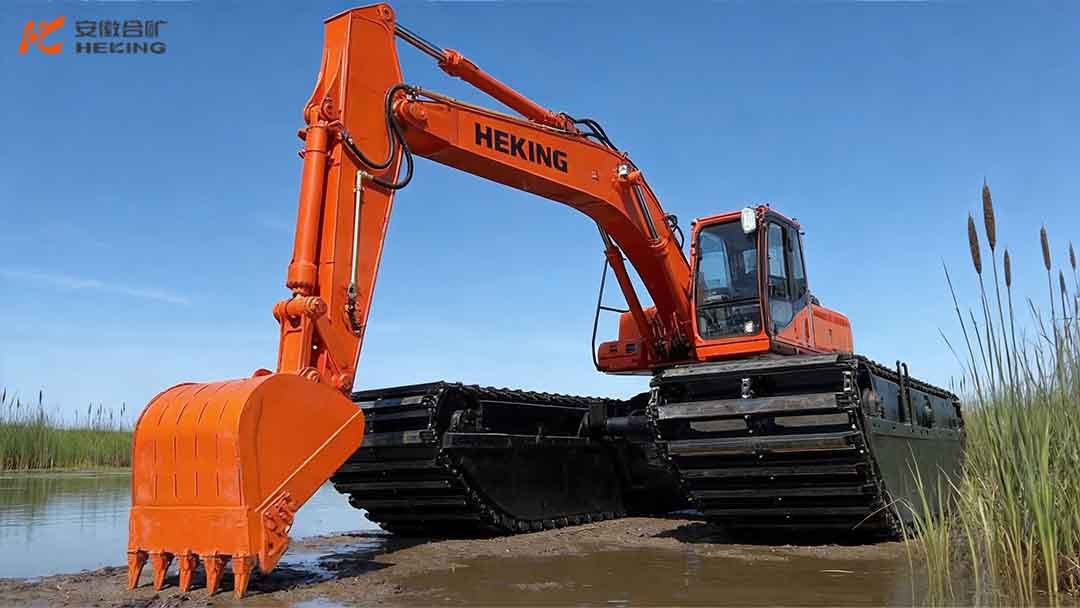
What Is an Amphibious Excavator?
An amphibious excavator is a specialized construction machine developed for operations in wetlands, swamps, shallow water, rivers, and other unstable environments.
Unlike standard crawler excavators, an amphibious excavator uses a floating undercarriage system consisting of pontoons and reinforced tracks. The pontoon structure provides additional buoyancy and reduces ground pressure, allowing the machine to work in soft soil, mud, and water-covered areas.
The main purpose of an amphibious excavator is to extend excavation capability beyond normal construction environments. It is commonly used for projects that require sediment removal, channel maintenance, shoreline work, and environmental engineering.
For river dredging projects, amphibious excavators are applied when working areas include:
Soft riverbanks
Muddy riverbeds
Shallow water zones
Flood control channels
Wetland restoration areas
Difficult-access water environments
How Does an Amphibious Excavator Work?
An amphibious excavator works by integrating a conventional excavator operating system with a specially designed floating undercarriage.
The upper structure provides excavation functions, including boom movement, bucket operation, and material handling. The amphibious undercarriage supports machine movement and stability in unstable environments.
Main Components of an Amphibious Excavator
Amphibious Pontoon Undercarriage
The pontoon undercarriage is one of the most important components of an amphibious excavator.
It provides:
Additional buoyancy support
Reduced ground pressure
Improved stability on soft surfaces
Better mobility in muddy and wet environments
Different excavator weight classes require different pontoon sizes and configurations. HEKING provides amphibious pontoon systems suitable for different excavator classes, including solutions for 7-8 ton, 12-15 ton, 20-22 ton, 24-27 ton, and 30-33 ton excavators.
Reinforced Track System
The track system is designed to support movement in challenging terrain.
Features may include:
Strengthened track shoes
Reinforced chains
Multiple travel motors
Improved traction performance
These features help the machine move across soft ground and maintain operational stability during dredging activities.
Excavation System
The excavator working equipment performs tasks such as:
Sediment excavation
River channel cleaning
Material removal
Bank shaping
For different project requirements, machines may be equipped with different boom configurations, buckets, or long-reach options.
Key Features and Advantages
An amphibious excavator provides several technical advantages for river dredging projects where working conditions are affected by water, unstable soil, and limited accessibility.
Compared with conventional excavators, amphibious excavators are designed to improve machine adaptability in challenging environments through specialized undercarriage systems and application-focused configurations.
Low Ground Pressure Operation
River dredging areas often contain soft mud, wet soil, and unstable surfaces. Excessive ground pressure can cause conventional equipment to sink or lose mobility.
The amphibious pontoon undercarriage distributes machine weight over a larger contact area, helping reduce pressure on soft terrain. This allows the equipment to operate in locations where standard crawler excavators may have difficulty.
Improved Stability in Wet Environments
Stability is an important requirement for dredging operations. Excavators working near or inside water need a stable platform to perform digging and material handling tasks.
The floating pontoon structure provides additional support and helps maintain machine balance during operations in shallow water, wetlands, and muddy areas.
Extended Working Range
River dredging projects often require excavation beyond the normal reach of standard machines.
Depending on project requirements, amphibious excavators can be configured with different working attachments and long-reach options. These configurations are suitable for applications requiring extended excavation distance, deeper access, or wider working coverage.
Adaptability to Different Project Conditions
Amphibious excavators are applied in various environments, including:
Rivers
Lakes
Wetlands
Swamps
Flood channels
Coastal engineering areas
The equipment configuration can be selected according to factors such as water depth, soil conditions, excavation distance, and project scale.
Main Applications
Amphibious excavators are used in multiple industries where excavation work requires additional mobility and stability in wet or unstable environments.
Waterway Maintenance
Application:
River dredging, sediment removal, and channel cleaning projects.
Requirement:
Waterways require regular maintenance to remove accumulated sediment and maintain flow capacity. Equipment must operate close to or inside water areas while maintaining excavation performance.
Suitable Solution:
An amphibious excavator with pontoon undercarriage can provide access to muddy river areas and shallow water zones for dredging operations.
Flood Control Projects
Application:
River channel improvement, flood prevention construction, and drainage system maintenance.
Requirement:
Flood control projects often involve soft ground, wet conditions, and large working areas where equipment mobility is important.
Suitable Solution:
Amphibious excavators are suitable for projects requiring excavation capability in unstable terrain and water-related environments.
Wetland Construction and Restoration
Application:
Wetland development, ecological restoration, and environmental protection projects.
Requirement:
Wetland areas usually have sensitive soil conditions and limited accessibility. Construction equipment needs to reduce environmental impact while completing excavation tasks.
Suitable Solution:
An amphibious excavator provides a practical option for excavation and material handling in marshes, wetlands, and soft ground areas.
Marine and Coastal Engineering
Application:
Coastal maintenance, shoreline improvement, and shallow water construction.
Requirement:
Marine-related projects require equipment capable of operating near water with suitable stability and mobility.
Suitable Solution:
Heavy-duty amphibious excavators with suitable pontoon systems can support excavation work in coastal and shallow water environments.
Energy and Pipeline Projects
Application:
Oil and gas pipeline construction in wetlands and difficult-access areas.
Requirement:
Pipeline projects may cross swamps, marshes, and soft terrain where transportation and excavation challenges exist.
Suitable Solution:
Amphibious excavators can support trench excavation and site preparation in areas with limited ground support conditions.
Important Factors to Consider When Choosing an Amphibious Excavator
Selecting an amphibious excavator requires careful evaluation of project requirements, operating conditions, and equipment specifications.
Working Environment
The first consideration is the actual jobsite condition.
Buyers should evaluate:
Water depth
Soil condition
Mud characteristics
River width
Access conditions
Required working area
Different environments may require different pontoon configurations or additional equipment options.
Excavator Size and Capacity
The machine size should match the project workload.
HEKING provides amphibious excavator models in different tonnage classes, including:
15-ton class amphibious excavators
20-ton class amphibious excavators
30-ton class amphibious excavators
35-ton class long-reach amphibious excavators
40-ton class heavy-duty amphibious excavators
A larger machine may provide higher excavation capacity, while smaller models may offer easier transportation and operation in limited areas.
Digging Reach Requirements
River dredging projects often involve excavation areas that are difficult to access directly.
Buyers should consider:
Required digging depth
Horizontal working distance
Bucket capacity
Boom configuration
For projects requiring extended reach, long-reach amphibious excavator configurations may be more suitable.
Pontoon System Design
The pontoon system directly affects equipment stability and mobility.
Important factors include:
Pontoon size
Buoyancy capacity
Track design
Extendable undercarriage options
Additional pontoon requirements
A suitable pontoon configuration helps ensure stable operation in different water and soil conditions.
Amphibious Excavator Models for River Dredging Projects
Different river dredging projects require different equipment capabilities. HEKING offers several amphibious excavator models designed for different working conditions.
HK200SD Amphibious Excavator
The HK200SD is designed for medium-scale wetland and river projects.
Typical applications include:
River dredging
Wetland construction
Swamp operations
It provides a balance between mobility and excavation capability for projects requiring flexible operation.
HK300SD Amphibious Excavator
The HK300SD is designed for river dredging, wetland construction, oil and gas pipeline projects, flood control projects, and coastal engineering applications.
The model uses a 30-ton class excavator platform and is suitable for contractors requiring higher excavation capability in challenging environments.
HK300SDA Long-Reach Amphibious Excavator
The HK300SDA is designed for projects requiring extended working distance.
It is suitable for:
Deep water dredging
Large-scale wetland projects
Applications requiring longer excavation reach
HK400SD Heavy-Duty Amphibious Excavator
The HK400SD is designed for heavy-duty applications requiring larger excavation capability.
It is suitable for:
Large river dredging projects
Deep water operations
Heavy excavation tasks
The model can be configured with additional pontoon and spud options for specific deep-water working requirements.
Comparison Section
Traditional Excavator vs Amphibious Excavator for River Dredging
Selecting suitable equipment for river dredging depends largely on ground conditions, water environment, and project requirements.
| Comparison Factor | Traditional Excavator | Amphibious Excavator |
|---|---|---|
| Working Environment | Suitable for stable ground conditions | Designed for wetlands, shallow water, mud, and soft terrain |
| Ground Support | Requires stronger ground bearing capacity | Uses pontoon undercarriage to improve flotation and stability |
| Soft Soil Operation | May have mobility limitations | Suitable for unstable and muddy environments |
| Water Area Access | Limited operation capability in water | Designed for water-related excavation applications |
| Transportation Requirement | Usually requires prepared access roads | Can access areas with limited ground support |
| Main Applications | General construction and earthwork | River dredging, wetland construction, flood control, environmental projects |
For projects located on stable land, a standard excavator may meet operational requirements. However, when excavation areas include soft ground, wetlands, or shallow water, an amphibious excavator provides additional adaptability.
Standard Amphibious Excavator vs Long-Reach Amphibious Excavator
Different dredging projects may require different working ranges.
| Comparison Factor | Standard Amphibious Excavator | Long-Reach Amphibious Excavator |
|---|---|---|
| Working Distance | Suitable for normal excavation range | Designed for extended excavation distance |
| Typical Application | River maintenance and wetland construction | Deep water dredging and wider access areas |
| Equipment Configuration | Standard boom and arm setup | Extended boom and arm configuration |
| Project Type | Medium-scale excavation tasks | Projects requiring increased reach capability |
The choice between standard and long-reach configurations depends on excavation depth, working distance, and project layout.
How to Select an Amphibious Excavator for River Dredging
Choosing the correct amphibious excavator requires more than comparing machine size. Buyers should evaluate the complete project environment and equipment requirements.
Define Project Requirements Before Purchasing
Before contacting a supplier, buyers should prepare basic project information, including:
Project location
Working environment
River or water area conditions
Required digging depth
Required excavation reach
Expected working hours
Transportation requirements
Providing detailed project information helps manufacturers recommend a suitable configuration.
Evaluate Key Equipment Specifications
Important specifications to review include:
Machine Weight
The excavator weight affects transportation requirements, working stability, and application range.
Different project scales may require different tonnage classes.
Maximum Digging Reach
Digging reach determines how far the machine can perform excavation work from its operating position.
For river dredging projects, longer reach capability can reduce repositioning requirements.
Bucket Capacity
Bucket capacity affects excavation efficiency and material handling capability.
The suitable bucket size depends on:
Material type
Sediment conditions
Project workload
Pontoon Configuration
The amphibious pontoon system should match the excavator size and working environment.
Buyers should ask suppliers about:
Pontoon dimensions
Buoyancy design
Track system
Extendable undercarriage options
Additional pontoon solutions
Questions Buyers Should Ask Suppliers
Before placing an order, professional buyers should confirm:
Is the machine suitable for my working environment?
What excavator size is recommended for my project?
What is the maximum digging reach?
What optional configurations are available?
Can the supplier provide customization services?
What are the production lead times?
What export and delivery support is available?
Are spare parts and technical support available?
Evaluate Manufacturer Capability
For international buyers, selecting a reliable manufacturer is an important part of procurement.
A suitable supplier should provide:
Manufacturing capability
Engineering support
Technical documentation
Export experience
Custom equipment solutions
After-sales communication
HEKING is an amphibious equipment manufacturer based in China, providing amphibious excavators, amphibious pontoon systems, crawler excavators, and customized equipment solutions for international customers.
Related Products
HEKING HK150SD Amphibious Excavator
Reason:
The HK150SD is suitable for smaller wetland and river projects where mobility and compact operation are important considerations.
HEKING HK200SD Amphibious Excavator
Reason:
The HK200SD provides a practical solution for medium-scale river dredging and wetland construction applications.
HEKING HK300SD Amphibious Excavator
Reason:
The HK300SD is designed for larger river dredging, flood control, wetland construction, and coastal engineering projects.
HEKING HK300SDA Long-Reach Amphibious Excavator
Reason:
The HK300SDA is suitable for applications requiring extended digging reach and wider working coverage.
HEKING HK400SD Heavy-Duty Amphibious Excavator
Reason:
The HK400SD is developed for heavy excavation tasks requiring higher machine capacity in challenging water and soft-ground environments.
Amphibious Pontoon Undercarriage System
Reason:
The amphibious pontoon system allows compatible excavators to operate in wetlands, shallow water, and soft terrain conditions.
FAQ
Q1: What is an amphibious excavator used for?
A:
An amphibious excavator is used for excavation projects in wetlands, rivers, swamps, shallow water areas, and other environments where ground stability is limited. Common applications include river dredging, flood control, wetland construction, and environmental restoration.
Q2: Why are amphibious excavators suitable for river dredging?
A:
Amphibious excavators use pontoon undercarriage systems that provide buoyancy and reduce ground pressure. This allows them to operate in muddy areas, soft riverbanks, and shallow water environments where conventional excavators may have limitations.
Q3: Can an amphibious excavator work in deep water?
A:
Amphibious excavators can be configured for different water-related applications. For deeper water projects, additional equipment options such as extra pontoons and spud systems may be considered according to project requirements.
Q4: What size amphibious excavator is suitable for river dredging?
A:
The suitable size depends on project scale, excavation requirements, working conditions, and transportation limitations. Small projects may use compact models, while larger dredging projects may require 30-ton or 40-ton class amphibious excavators.
Q5: What is the difference between a swamp excavator and an amphibious excavator?
A:
A swamp excavator is commonly designed for soft ground applications, while an amphibious excavator usually includes floating pontoon systems that allow operation in both soft terrain and water-related environments.
Q6: How does an amphibious excavator prevent sinking?
A:
The amphibious pontoon undercarriage increases flotation support and distributes machine weight over a larger area. This helps reduce ground pressure when operating on mud, wetlands, and unstable surfaces.
Q7: Can amphibious excavators be customized?
A:
Yes. Depending on project requirements, manufacturers may provide customization options such as long-reach configurations, extendable undercarriages, additional pontoons, and spud systems.
Q8: What information should buyers provide when requesting a quotation?
A:
Buyers should provide project details such as working environment, water depth, required digging reach, excavation tasks, project scale, and delivery location. This information helps suppliers recommend suitable equipment.
Q9: How long does it take to manufacture an amphibious excavator?
A:
Production time depends on the model, configuration, and customization requirements. Buyers should confirm lead time directly with the manufacturer before ordering.
Q10: What should international buyers consider when importing an amphibious excavator?
A:
International buyers should consider machine specifications, transportation arrangements, technical documents, payment terms, supplier experience, spare parts support, and after-sales communication.