
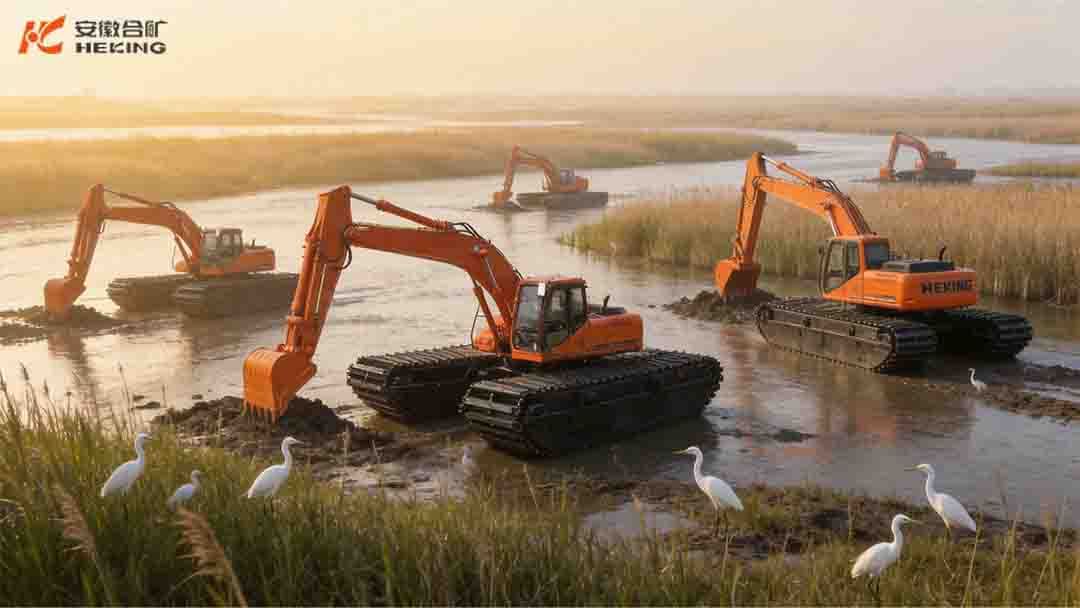
River dredging projects frequently involve soft riverbanks, saturated ground, mud, shallow water, and unstable working surfaces where a conventional crawler excavator may have limited access. An amphibious excavator is designed for these conditions by combining an excavator with a buoyant pontoon-based undercarriage and wide, low-pressure tracks.
For contractors and project owners, choosing an amphibious excavator for river dredging is not simply a matter of selecting the largest machine available. Flotation, ground pressure, digging reach, working depth, hydraulic performance, machine dimensions, track configuration, and transport requirements all influence whether a machine is appropriate for a particular project.
This guide explains the main selection considerations and reviews the specifications of the HEKING HK150SD, HK200SD, and HK300SD amphibious excavators provided for this application.
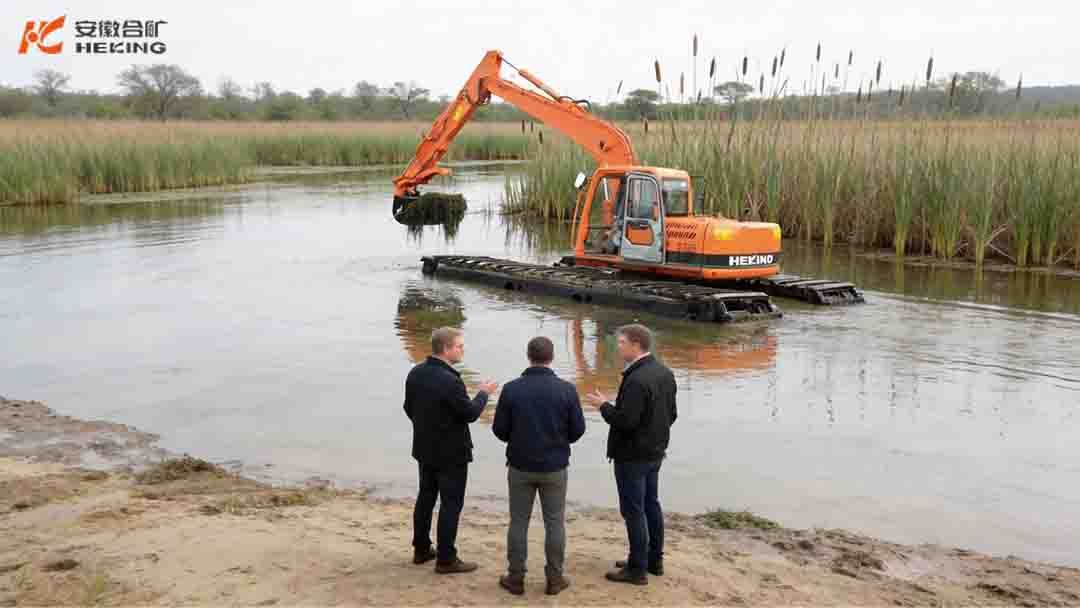
Why Amphibious Excavators Are Used for River Dredging
River dredging can require excavation from positions that are difficult for standard land-based construction machinery to reach. The operating surface may include saturated soil, mud, wetlands, shallow water, or soft riverbanks.
An amphibious excavator addresses this type of access problem through its pontoon undercarriage. The buoyant structure supports the machine while the track system provides mobility across suitable soft terrain and shallow-water working areas.
For river dredging, the main advantages of this configuration are related to access and working stability under conditions where conventional equipment may experience excessive ground pressure or difficulty reaching the excavation area.
The appropriate machine still depends on actual site conditions. Water depth, soil condition, required excavation reach, access route, dredging method, and the material being handled should be assessed before equipment selection.
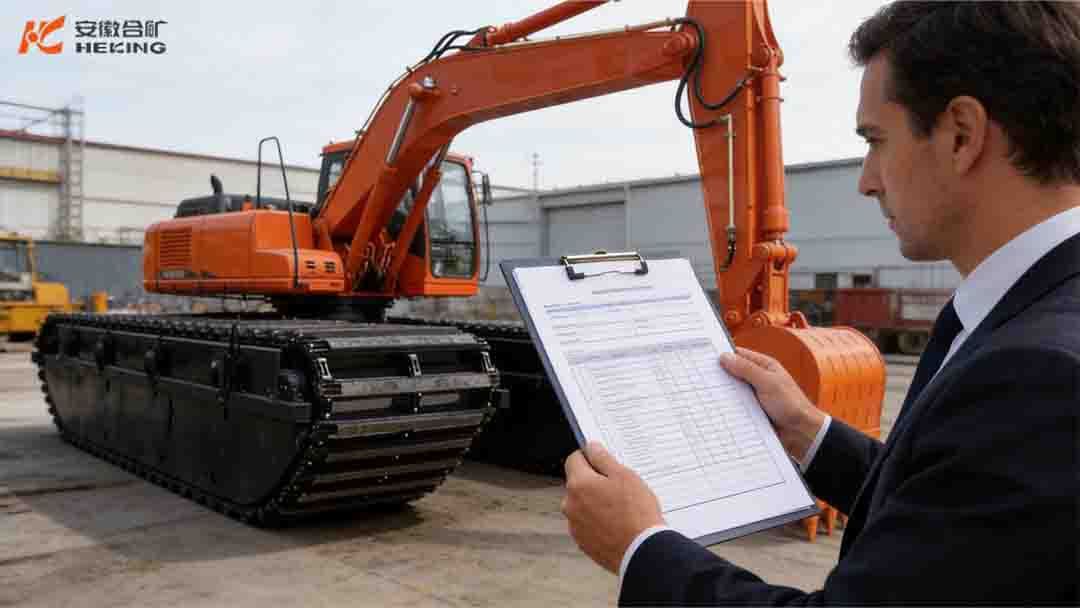
Key Factors When Choosing an Amphibious Excavator for River Dredging
Flotation and Pontoon Configuration
Flotation is one of the first considerations when an excavator will operate in or around water.
A pontoon undercarriage provides buoyancy while supporting the upper structure. The supplied HEKING models use amphibious pontoon systems, with the HK150SD specifically described as having four motors, strengthened track shoes and chains, large buoyancy, and a hydraulic extendable undercarriage.
The HK200SD is available with a manual extendable undercarriage or a hydraulic extendable undercarriage as an option.
For a project involving variable ground conditions, an extendable undercarriage can be an important specification to evaluate because track gauge and overall width change according to the configuration.
Ground Pressure
Ground pressure matters when the excavator must travel across soft or saturated ground.
The supplied specifications list ground pressure of:
| Model | Operating Weight | Ground Pressure |
|---|---|---|
| HK150SD | 15,000 kg | 0.13 kg/cm² |
| HK200SD | 20,000 kg | 0.14 kg/cm² |
| HK300SD | 30,000 kg | 0.14 kg/cm² |
These figures should not be considered independently. A buyer should evaluate them together with soil bearing capacity, water conditions, machine configuration, attachment weight, and the intended travel route.
Digging Reach and Working Depth
The required digging envelope is another major consideration for river dredging.
The supplied specifications show the following maximum digging reach:
| Model | Maximum Digging Reach | Maximum Digging Depth |
|---|---|---|
| HK150SD | 8,996 mm | 5,879 mm |
| HK200SD | 10,778 mm | 7,033 mm |
| HK300SD | 10,186 mm | 3,201 mm |
The numbers demonstrate why machine selection should be based on the actual excavation geometry rather than operating weight alone.
For example, a project requiring greater horizontal reach may place different priorities on machine configuration than a project focused on deeper excavation. Contractors should also distinguish between maximum digging depth, vertical digging depth, and the actual working depth required at the river.
Hydraulic System
Dredging productivity depends partly on the hydraulic system's ability to operate the excavator and its attachment under the intended working conditions.
The provided specifications include variable plunger pumps across the three models. The listed working pressures are 26.5 MPa for the HK150SD, 30 MPa for the HK200SD, and 32 MPa for the HK300SD.
For procurement, hydraulic specifications should be evaluated alongside the planned attachment and operating cycle. If a special dredging attachment is required, the buyer should confirm compatibility with the excavator's hydraulic configuration before ordering.
Track Gauge and Overall Width
Track gauge and overall machine width are particularly important for amphibious equipment because they affect working stability, transportation, and access.
The HK150SD has a listed track gauge of 2,050–3,100 mm and overall width of 3,500–4,548 mm.
The HK200SD has a track gauge of 2,598–3,398 mm and an overall width of 4,231 mm when retracted and 5,051 mm when extended.
The HK300SD has a listed track gauge of 3,950 mm and overall width of 5,742 mm.
These dimensions should be checked against riverbank access, transportation restrictions, worksite limitations, and the required operating configuration.
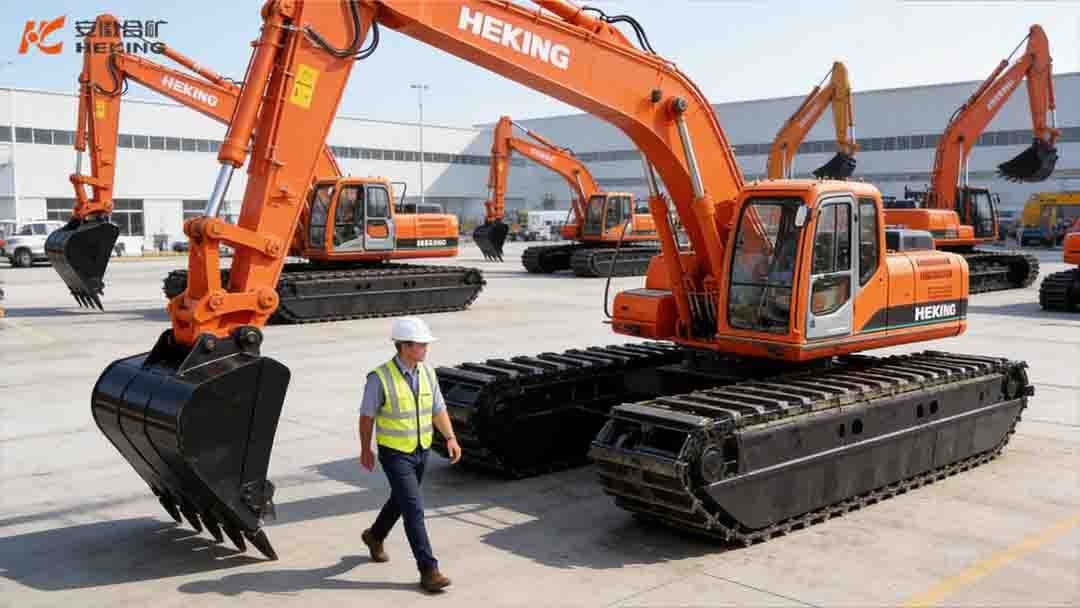
Comparing the HEKING Amphibious Excavator Models
The three supplied models cover different operating weight classes and have different dimensional and performance specifications.
HK150SD
The HK150SD has an operating weight of 15,000 kg and a standard bucket capacity of 0.25 m³. It uses a Yanmar 4TNV98T engine rated at 54.3 kW at 2,200 rpm.
Its maximum digging reach is 8,996 mm, while maximum digging depth is 5,879 mm. The listed ground pressure is 0.13 kg/cm².
The model is therefore a relevant option to evaluate for projects where a 15-ton-class amphibious excavator is appropriate and the required excavation envelope fits within its specifications.
HK200SD
The HK200SD has an operating weight of 20,000 kg and a standard bucket capacity of 0.4 m³. Its Mitsubishi 4D34 engine is rated at 70 kW at 2,200 rpm.
The model provides a maximum digging reach of 10,778 mm and maximum digging depth of 7,033 mm. It has a listed ground pressure of 0.14 kg/cm².
The HK200SD also provides manual or hydraulic extendable undercarriage configurations, with the hydraulic version listed as optional. This makes undercarriage configuration an important point for buyers to clarify during quotation and technical discussions.
HK300SD
The HK300SD is the largest of the three supplied models, with an operating weight of 30,000 kg and a standard bucket capacity of 0.8 m³.
It is specified with a Mitsubishi 4M50-TLC3J engine, with an Isuzu 6BG1TRP-03 listed as an optional engine. Engine power is specified at 118 kW at 2,000 rpm.
The model has a maximum digging reach of 10,186 mm and a listed maximum digging depth of 3,201 mm. Its applications in the supplied information include river dredging, wetland construction, oil and gas pipeline projects, flood control projects, and coastal engineering.
For larger projects, the higher operating weight and bucket capacity may make the HK300SD worth evaluating, but final selection should still be based on the actual excavation geometry and site conditions.
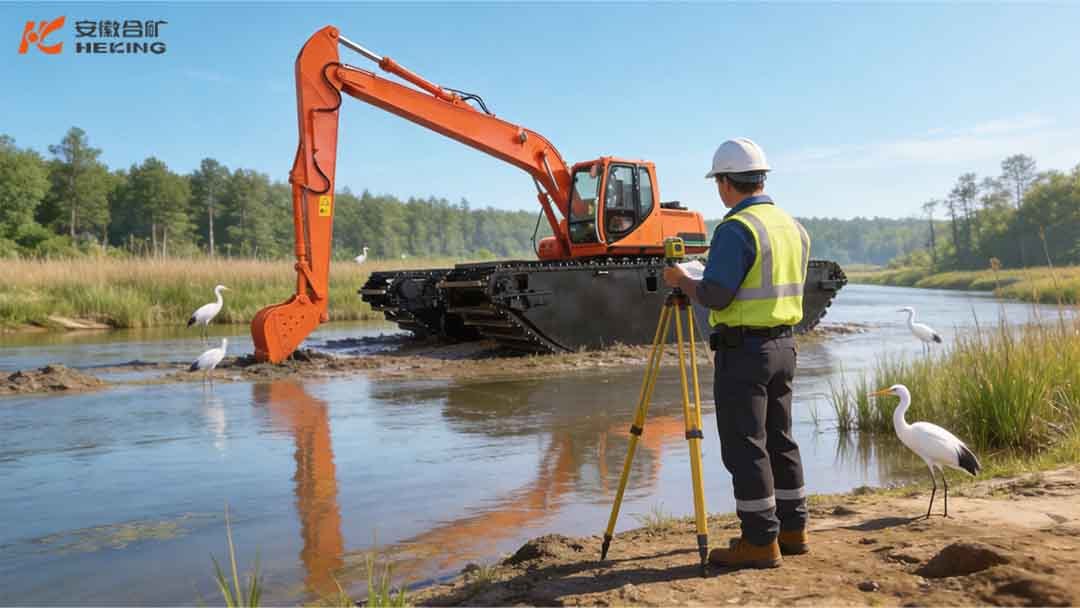
Which Amphibious Excavator Is Suitable for River Dredging?
There is no single machine size that is automatically suitable for every river dredging project.
A practical selection process starts with the worksite rather than the machine model.
Consider these questions:
How soft is the riverbank or working surface?
Will the excavator work primarily on land, in shallow water, or across both?
What digging reach is required from the machine's working position?
What excavation depth is required?
What bucket capacity is appropriate for the planned operation?
What track gauge is required for the operating condition?
What are the transportation width and access limitations?
What attachment will be installed?
Does the project require an extendable undercarriage?
What are the local ground and water conditions?
For example, a contractor working on a relatively compact project may first evaluate the HK150SD or HK200SD based on required reach, depth, bucket capacity, and access conditions. A larger project requiring a 30-ton-class machine may justify evaluating the HK300SD.
The correct choice should be confirmed against the project's engineering requirements rather than based only on the nominal tonnage.
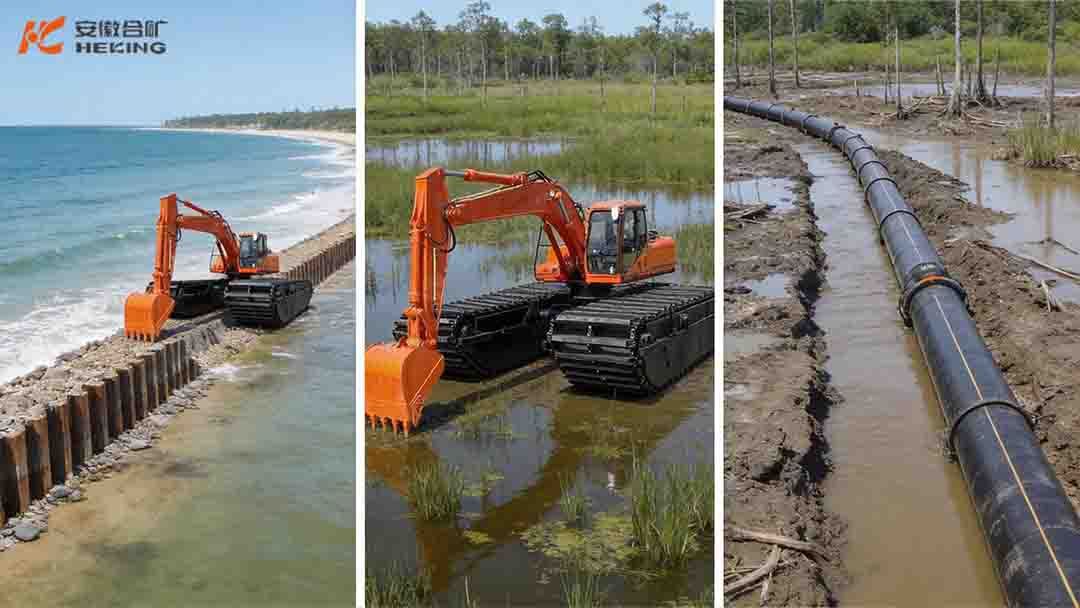
Amphibious Excavator Applications Beyond River Dredging
River dredging is one important application, but amphibious excavators can also be considered for other projects involving soft or water-affected working environments.
The supplied HEKING information identifies applications including:
Wetland Construction
Wetland construction can involve saturated ground and soft terrain where conventional excavation equipment may face access limitations. An amphibious undercarriage provides a platform specifically intended for these challenging working conditions.
Flood Control Projects
Flood-control work may involve waterways, riverbanks, channels, and other areas where machine access is affected by water or unstable ground. Equipment selection should be based on the specific excavation and maintenance requirements.
Coastal Engineering
Coastal projects can involve wet and unstable working surfaces. The HK300SD information specifically identifies coastal engineering among its applications.
Oil and Gas Pipeline Projects
Pipeline construction and maintenance can require equipment capable of operating in difficult terrain. The supplied HK300SD application information includes oil and gas pipeline projects.
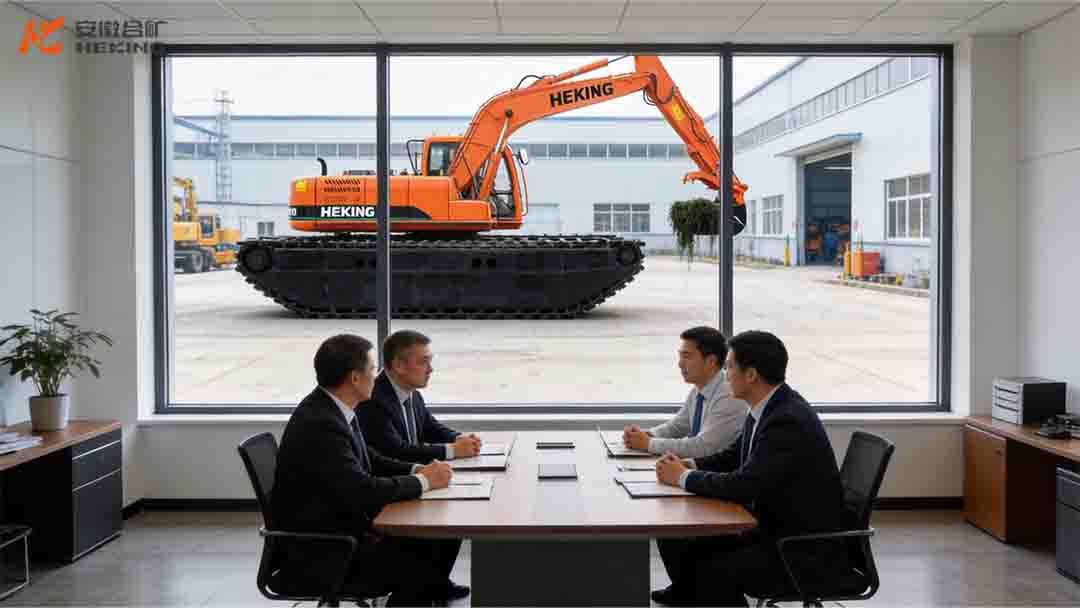
What Should Buyers Ask an Amphibious Excavator Manufacturer?
For international procurement, technical specifications are only one part of the purchasing decision. Buyers should also clarify how the proposed machine configuration relates to their project.
Useful questions include:
Which excavator model matches the required operating weight and digging envelope?
What undercarriage configuration is included in the quotation?
Is the undercarriage manual or hydraulically extendable?
What are the machine dimensions in transport and working configurations?
What attachment and bucket configuration is included?
What hydraulic specifications are available for the intended attachment?
What are the pontoon dimensions?
What is the stated ground pressure?
What engine and major hydraulic components are specified?
What production time applies to the selected configuration?
What payment terms apply?
Can the manufacturer provide technical support for project-specific requirements?
These questions help procurement teams compare quotations on technical scope rather than comparing machine prices alone.
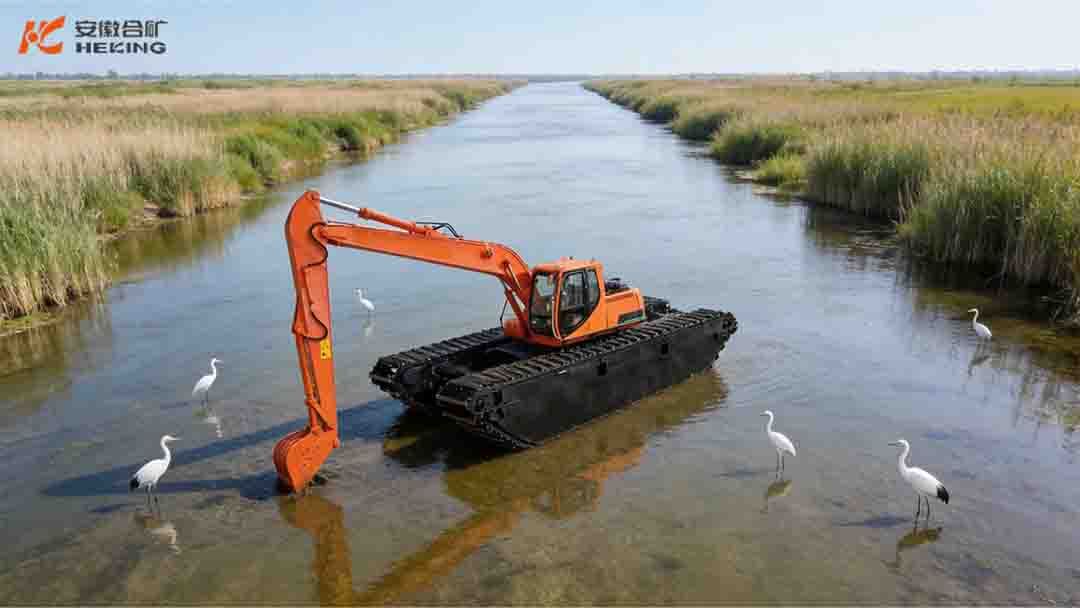
Why Project Conditions Matter More Than a Generic "Best" Machine
The phrase "best amphibious excavator" can be misleading because river dredging conditions vary significantly from one project to another.
A machine with a larger bucket may be useful where higher excavation capacity is required, while another project may place greater importance on digging reach, working depth, machine width, or transport limitations.
Similarly, a larger operating weight does not automatically mean better suitability. The machine must match the site's access conditions, required excavation envelope, and working configuration.
For professional buyers, the more useful question is:
Which amphibious excavator configuration matches the project's operating conditions and excavation requirements?
That approach provides a more reliable basis for technical comparison and procurement.
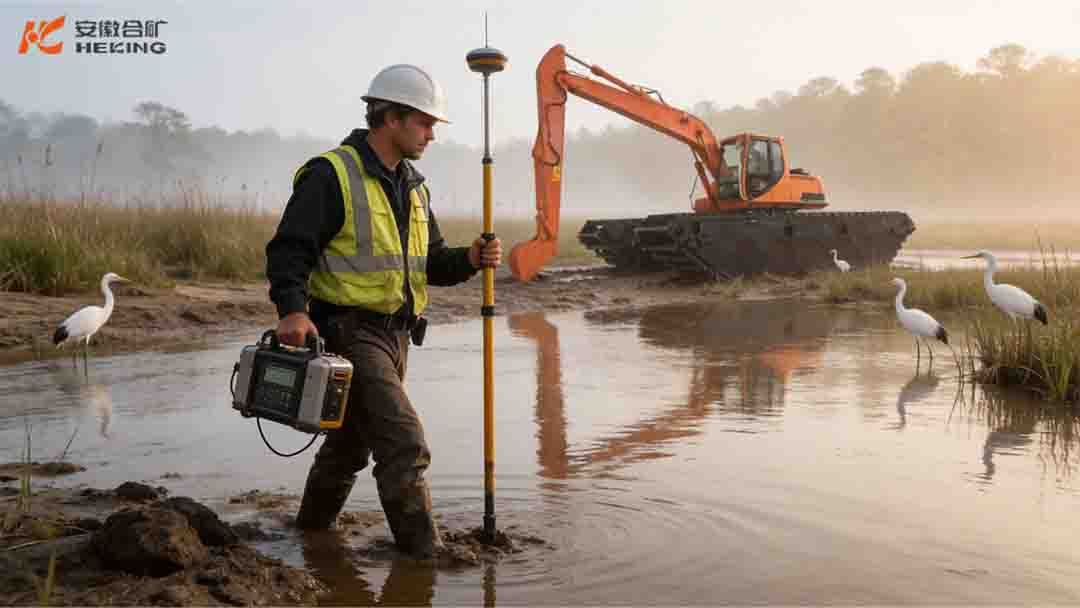
HEKING Amphibious Excavators for River and Wetland Projects
HEKING is the brand of Anhui Hekuang Environmental Technology Co., Ltd., a manufacturer specializing in amphibious equipment and construction machinery for wetland, water, and environmental engineering projects.
The company operates a production base covering more than 100,000 square meters and has a team of 125 employees, including 42 technical specialists and 10 senior professional engineers.
Its amphibious excavator range includes 15-ton, 20-ton, 30-ton, and 40-ton classes. The company also provides amphibious undercarriage pontoon systems and OEM/ODM services.
For projects requiring customized equipment, the supplied company information identifies engineering capabilities involving long-reach excavators, extendable amphibious chassis, additional side pontoons, and spud pile systems for operations in water depths of up to 3 meters.
For an actual river dredging project, the appropriate configuration should be confirmed with the manufacturer according to the site's water depth, ground conditions, required reach, attachment, and working method.
FAQ
What is an amphibious excavator used for in river dredging?
An amphibious excavator is used where excavation work takes place on soft ground, wetlands, riverbanks, shallow water, or other difficult working surfaces. Its pontoon-based undercarriage provides buoyancy and a working platform for these conditions.
How do I choose an amphibious excavator for river dredging?
Start with the required digging reach, digging depth, bucket capacity, ground pressure, water and soil conditions, track configuration, transportation dimensions, and planned attachment. The machine should be selected according to actual project requirements rather than operating weight alone.
What is the ground pressure of the HEKING amphibious excavators?
The supplied specifications list 0.13 kg/cm² for the HK150SD and 0.14 kg/cm² for both the HK200SD and HK300SD. Actual suitability should be evaluated against the project's ground conditions and machine configuration.
Does the HK200SD have an extendable undercarriage?
Yes. The supplied information lists a manual extendable undercarriage and a hydraulic extendable undercarriage as an optional configuration for the HK200SD.
Which HEKING model has the largest bucket capacity among the supplied models?
Among the HK150SD, HK200SD, and HK300SD specifications provided here, the HK300SD has the largest standard bucket capacity at 0.8 m³.
Can an amphibious excavator be used for wetland construction?
Yes. Wetland construction is one of the applications identified in the supplied HEKING information. The actual machine configuration should be evaluated according to the ground, water, excavation, and access conditions of the project.
Conclusion
Selecting an amphibious excavator for river dredging requires more than comparing machine tonnage. Flotation, ground pressure, digging reach, working depth, bucket capacity, hydraulic specifications, track gauge, overall dimensions, and undercarriage configuration all affect practical suitability.
The HEKING HK150SD, HK200SD, and HK300SD provide different operating weight classes and technical configurations for evaluation. The HK150SD is a 15-ton-class machine, the HK200SD is a 20-ton-class model with optional extendable undercarriage configurations, and the HK300SD is a 30-ton-class machine with a 0.8 m³ standard bucket and applications including river dredging, wetland construction, flood control, and coastal engineering.
For a specific river dredging project, buyers should provide the manufacturer with working conditions, required reach and depth, attachment requirements, access limitations, and site conditions before requesting a final configuration and quotation.
Request an Amphibious Excavator Configuration
If you are evaluating an amphibious excavator for river dredging, wetland construction, flood control, or another water-related project, discuss your operating conditions with HEKING.
Provide the required excavation reach, working depth, water and ground conditions, expected attachment, transportation requirements, and preferred machine class. The manufacturer can then evaluate the appropriate equipment configuration and provide technical and commercial information for your project.